
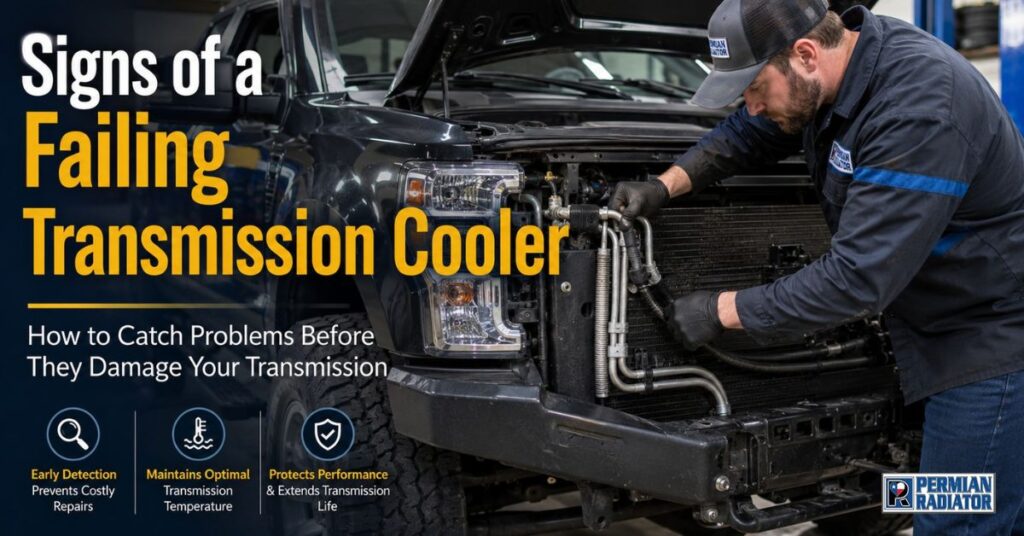
If you’re trying to figure out whether your transmission cooler is going bad, the short answer is this: watch for signs of a failing transmission cooler like reddish fluid leaks under the vehicle, a burnt smell, rising transmission temperatures, slipping or harsh shifts, and a check engine or transmission-temp warning light. Catch any one of these early, and you’re usually looking at a repair. Ignore them, and you’re often looking at a rebuilt or replaced transmission instead.
- A transmission cooler keeps your transmission fluid in a safe temperature range. When it fails, fluid overheats and stops protecting your gears.
- The five warning signs: fluid leaks, burnt smell, overheating, shifting problems, and dashboard warning lights.
- Don’t keep driving on it. Overheated fluid causes damage that gets expensive fast.
- Sometimes it’s a simple line or flush. Sometimes the “cooler” symptom is actually a deeper transmission issue, and a real diagnosis tells you which.
- For heavy-duty and fleet equipment in the San Angelo and Permian Basin area, a cooling specialist can repair, rebuild, or replace coolers and lines to cut downtime.
What does a transmission cooler actually do?
Your transmission makes a lot of heat. Towing, hauling, idling in the heat, or working under load make a lot more.
A transmission fluid cooler is a small heat exchanger; think of it as a mini radiator for your transmission fluid. Fluid circulates through it, dumps heat, and returns cooled so it can keep lubricating and pressurizing the transmission.
When that cooling stops working, fluid temperature climbs. Hot fluid breaks down, loses its protective film, and the internal parts start grinding metal on metal. That’s the chain reaction that every one of the symptoms below is warning you about.
In short, the cooler protects the fluid, and the fluid protects the transmission. Lose the cooler, and you eventually lose both.
What are the signs of a failing transmission cooler?
Here are the symptoms worth knowing, roughly in the order people usually notice them.
1. Reddish or brown fluid leaking under the vehicle
Transmission fluid is typically reddish or, when it’s aged, brownish. A puddle near the front or middle of the vehicle often points to a cracked cooler or a transmission cooler line leak.
Cooler lines take constant abuse, heat, vibration, and road debris, making them brittle over time. The leak itself may be a cheap fix, but the dropping fluid level is what does the damage.
2. A burnt smell
If you catch a burnt, acrid odor, your fluid is likely overheating. Once transmission fluid passes roughly 225°F, it starts to cook, darken, and lose its protective qualities.
A burnt smell means damage may already be in progress. Treat it as a “stop and check it” signal, not a “deal with it later” one.
3. The transmission runs hot
Many trucks and heavy-duty rigs show transmission temperature on a gauge or display. A reading that keeps climbing or a unit that drops into “limp mode” to protect itself frequently traces back to a clogged transmission cooler or poor flow.
On equipment without a gauge, this one often hides until another symptom shows up. That’s part of why heavy-duty operators add temperature monitoring.
4. Slipping gears or rough, delayed shifts
When cooling fails, fluid thins and pressure drops. That can cause slipping gears, harsh engagement, or a lag before the transmission grabs.
It feels like a transmission problem because, functionally, it is one just upstream of where you’d expect.
5. Check the engine or transmission warning light
A struggling transmission cooler can trigger a dashboard warning. Heat from the transmission can also push engine temperatures up, which is why a check engine light sometimes shows alongside transmission trouble.
Don’t clear the code and keep going. The light is doing its job.
In short: Leaks, burnt smell, high temps, bad shifts, and warning lights are the five to watch. Any one of them earns a look.
You can also read: Hydraulic Oil Cooler Repair: Common Issues and Solutions
Symptom severity: what’s urgent and what can wait a day
Not every symptom is a roadside emergency, but a couple are close. Here’s a practical way to triage it.
Symptom | Likely cause | How urgent | Risk if ignored |
Small reddish leak, no temp change | Cooler line or fitting | Soon, within days | Fluid loss → overheating |
Burnt smell | Fluid overheating now | Urgent | Internal wear, fluid breakdown |
Temp gauge climbing/limp mode | Clogged or failed cooler | Urgent: Stop driving | Sudden transmission failure |
Slipping or harsh shifts | Low pressure from heat/fluid loss | Urgent | Gear and clutch damage |
Warning light only | Varies needs scan | Get it diagnosed | Depends on root cause |
When in doubt, the safe move is to stop driving and get it scanned. A transmission that fails on the highway or in the field costs far more than an inspection.
Can you drive with a bad transmission cooler?
You shouldn’t, and here’s the honest reasoning.
A failing cooler lets fluid overheat. Overheated fluid stops protecting the transmission, so every mile adds wear you can’t undo. A unit that’s running hot can also fail suddenly, leaving you stranded or stranding a truck that’s supposed to be earning.
If you’re already seeing high temps, slipping, or a burnt smell, driving long distances is the riskiest choice you can make. Get it looked at before the next big run.
In short: Short trip to a shop, maybe. Loaded haul across the Basin, no.
What causes a transmission cooler to fail?
A few usual suspects:
- Age and vibration crack lines and fittings over time.
- Debris and sludge clog the cooler internally, killing flow.
- Heavy, sustained loads, towing, hauling, and oilfield duty push coolers past their comfort zone.
- Old, contaminated fluid that’s never been serviced gums up the system.
- Physical damage from rocks, road debris, or a hard hit.
For fleets and equipment that work hard, heat and load are the big two. That’s also why a properly sized heavy-duty transmission cooler and regular fluid service matter more on commercial gear than on a commuter car.
Repair, rebuild, or replace? A simple decision framework
This is where most articles stop being useful. Here’s how a cooling specialist actually thinks about it.
- Leak at a line or fitting? Often, a straightforward line repair or replacement.
- Cooler clogged but intact? A transmission cooler flush can restore flow and clear contaminants.
- Cooler cracked, corroded, or failed internally? Replacement is usually the right call; a patched heat exchanger rarely holds up under load.
- Symptoms remain after the cooler is fixed? Now you’re likely looking at a deeper transmission issue, not a cooling one.
That last point is the honest part: not every “cooler” symptom is the coolest. Slipping and rough shifts can come from internal transmission wear that a cooler repair won’t touch. A real diagnosis, fluid inspection, pressure test, and temperature check across the cooler tell you which problem you actually have before you spend money on the wrong fix.
In short: Line leak → repair. Clog → flush. Failed cooler → replace. Symptoms after that → diagnose the transmission itself.
Why does this hit harder for fleets and heavy-duty operators
For a daily driver, a bad cooler is an inconvenience. For a fleet, an oilfield rig, or a hauling operation, it’s downtime, and downtime is the real cost.
A truck waiting on a transmission isn’t moving freight. A frac or construction unit that’s down stalls a whole job. That’s why proactive cooling system inspection, cleaning, flushing, and pressure testing pay off for commercial operators: it’s cheaper to catch a tired cooler during scheduled service than to lose a unit mid-route.
This is the niche Permian Radiator works in: commercial, industrial, heavy-duty, and automotive cooling systems, serving San Angelo and the broader Permian Basin. The goal is simple: keep your equipment running and your downtime short.
Expert tip: If you run heavy-duty equipment, log your transmission temps under load. A unit that creeps a few degrees hotter than usual is often the earliest warning you’ll get, long before a leak or a light.
How a shop diagnoses a transmission cooler problem
A thorough check usually includes:
- Fluid inspection‘s color, smell, and level tell a story fast.
- Pressure testing pressurises the lines to pinpoint leaks.
- A temperature differential check comparing fluid temp before and after the cooler reveals a clog; little to no temperature drop means it isn’t doing its job.
- Visual inspection of lines, fittings, and the cooler body for cracks, corrosion, and debris.
These steps separate a simple line fix from a failed cooler from a transmission problem, so you’re not guessing and not paying for parts you don’t need.
FAQs
Usually, a reddish fluid leak or a burnt smell, followed by rising transmission temperatures and shifting problems. A warning light may appear at any point.
Often yes. If the cooler is intact but blocked, a flush can clear contaminants and restore flow. A cracked or internally failed cooler needs replacement.
It depends entirely on the issue. A line repair is modest, a flush is moderate, and a full cooler replacement costs more, with heavy-duty units running higher than passenger cars. A proper diagnosis gives you an accurate number rather than a guess.
Not exactly. Some vehicles route transmission fluid through a section of the radiator; many trucks and heavy-duty rigs also have a separate auxiliary cooler. Both do the same job, pulling heat out of the fluid.
Towing and heavy loads create far more heat than normal driving. If the cooler is undersized, clogged, or failing, it can't keep up, and temperatures climb. Upgrading to a properly sized cooler is a common fix for equipment that works hard.
It can. A failing cooler may trigger a transmission or engine warning, partly because transmission heat can raise engine temperatures, too. Always have the code read rather than cleared.
Follow the manufacturer's schedule, and inspect more often if you run hard, tow heavy, or operate in heat and dust. For fleets, folding cooling checks into routine maintenance is the cheapest insurance against downtime.
Don’t wait for the cooler to take the transmission with it
The whole point of knowing the signs of a failing transmission cooler is timing. Caught early, it’s a line, a flush, or a cooler swap. Caught late, it’s a rebuilt or replaced transmission and a vehicle that’s out of service.
If you’re seeing leaks, smelling something burnt, watching temps climb, or feeling rough shifts on a daily driver or a piece of heavy-duty equipment, get it diagnosed before your next big run.
Permian Radiator repairs, rebuilds, and replaces transmission coolers, lines, and cooling systems for commercial, industrial, heavy-duty, and automotive customers across San Angelo and the Permian Basin.
Call now or request a free quote to schedule service and keep your equipment moving.


 ICONIER Digital Marketing Agency