
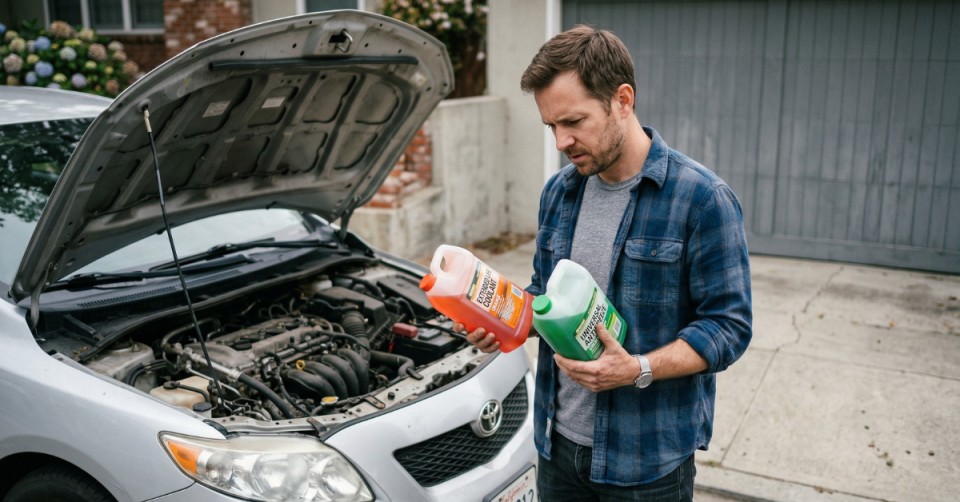
If you operate a daily driver, a diesel pickup, or a work truck in San Angelo, TX or Hobbs, NM, the “which coolant should I use?” question usually pops up at the worst time—right before a top-off, during a hot day, or when a warning light shows up. This guide breaks down coolant types in plain English so you can make a safer decision, protect your cooling system, and know when it’s time to bring the vehicle to a radiator shop.
Coolant vs antifreeze: plain-English definitions
What is coolant?
“Coolant” is the fluid mixture that circulates through the engine and radiator to help manage operating temperatures and protect internal metal surfaces from corrosion.
Antifreeze vs coolant—what’s the difference?
- Antifreeze is typically a concentrated chemical base (usually glycol) with additive packages (inhibitors).
- Engine coolant is usually antifreeze mixed with water (often sold as premixed 50/50, or mixed during service).
What are coolant used for?
Coolant does more than freeze protection. In real-world fleet use, it also helps with:
- Boil-over resistance (within the system’s design limits)
- Corrosion protection in aluminum, iron, solder, and mixed-metal systems
- Seal and gasket compatibility (depending on the chemistry)
- Diesel-focused protection needs like cavitation protection (more on that below)
What’s inside coolant: glycols, inhibitors, and premix vs concentrate
Ethylene glycol vs propylene glycol (base fluids)
Most vehicle coolant types use one of these bases:
- Ethylene glycol (EG): common in many coolant for car and light/heavy-duty applications; effective heat transfer but toxic if ingested.
- Propylene glycol (PG): sometimes used where lower toxicity is a priority; performance characteristics and OEM approvals can differ.
A practical note: the “base” is only half the story. The additive package is what usually determines whether it’s IAT/OAT/HOAT/ELC and whether it fits your engine.
Corrosion inhibitors (the protection package)
Think of inhibitors as a “protective chemistry” that helps reduce:
- Corrosion in mixed metals
- Scale formation
- Additive depletion over time (which is why service intervals matter)
This is where terms like IAT antifreeze, OAT coolant, and extended life coolant come from.
Premixed vs concentrate coolant
- Premixed (often 50/50): convenient, less guesswork, commonly used for top-offs.
- Concentrate: requires proper mixing with the correct water type and ratio per OEM guidance.
If you’re unsure what coolant does my car need, premixed can feel safer for topping off—but only if you’re confident it’s the correct spec and compatible with what’s already in the system.
Water quality matters. Hard tap water can contribute to scale and deposits over time, which may reduce heat transfer and complicate cooling-system performance.
Coolant types: IAT, OAT, HOAT, and ELC
Here’s the quick “decoder ring” for antifreeze/coolant types. Your owner’s manual or OEM spec sheet should be the final authority—especially for late-model vehicles and heavy-duty engines.
IAT (Inorganic Additive Technology)
- Often referred to as IAT coolants or “conventional green” (color is not a guarantee).
- Typically uses inhibitors like silicates/phosphates (formulations vary by region and OEM).
- Common in older vehicles and some legacy applications.
OAT (Organic Acid Technology)
- Commonly called OAT coolant.
- Uses organic acid inhibitors aimed at longer service life in many modern designs.
- Often found in newer passenger vehicles, but OEM spec is what matters.
HOAT (Hybrid OAT)
- A blend approach: organic acids plus select inorganic inhibitors.
- Often used by specific manufacturers for mixed-metal protection and performance needs.
ELC (Extended-Life Coolant) for heavy-duty applications
- Often called ELC coolant (extended-life coolant), and you’ll see terms like hd elc coolant in diesel contexts.
- Many heavy-duty ELCs are designed with liner/cavitation concerns in mind (depending on engine design) and may be nitrite or nitrite-free coolant formulations.
- Some fleets refer to manufacturer-aligned products (for example, Caterpillar ELC coolant)—but the important piece is meeting the OEM coolant specification, not the label.
If you’re asking what type of antifreeze or what type of coolant to run, the safest decision is to match the OEM spec first, then choose a reputable product that explicitly meets it.
Heavy-duty reality: diesel cavitation, nitrite, and ELC
In West Texas and Southeast New Mexico, work trucks and equipment often idle, pull loads, run long hours, and see wide temperature swings. That usage can make coolant chemistry and maintenance practices more consequential.
Cavitation protection (diesel) — high level
Some diesel engines (especially certain designs with wet cylinder liners) can be vulnerable to cavitation, where tiny vapor bubbles form and collapse, potentially damaging metal over time. Certain coolants and additive packages are designed to help manage that risk profile.
Nitrite vs nitrite-free coolant
- Some heavy-duty coolants use nitrites as part of the inhibitor package (common in certain traditional diesel strategies).
- Others are nitrite-free and rely on different inhibitor chemistry.
Either approach can be appropriate when it matches the OEM requirement.
Electrolysis / stray-current corrosion (high level)
Electrolysis is a broad “field term” people use when they’re worried about stray electrical current contributing to corrosion in a cooling system. The key takeaway: if corrosion shows up early, it’s worth having a shop check the system holistically (coolant condition, grounds, charging system health, and component integrity) rather than guessing.
You can also read: Coolant flush signs cost service guide
Compatibility, mixing, and the coolant color myth
The coolant color myth
Color can be a clue, not a spec. Different brands can dye similar chemistries different colors—and different chemistries can look similar. Relying on color alone is one of the fastest ways to create a mismatch.
Mixing coolant types: where problems start
Mixing different radiator fluid types can:
- Reduce inhibitor effectiveness
- Create sediment/gel/sludge in some combinations
- Change corrosion protection characteristics
- Complicate troubleshooting later (because the “baseline” chemistry is unknown)
If you’re in a pinch and asking “can I top off with what I have?” the safest approach is:
- Match the OEM spec if you can confirm it, and
- Avoid “universal” assumptions when the system’s current coolant type is unknown.
Common mistakes that damage cooling systems
- Topping off with an unknown coolant because “the color looks close”
- Mixing long life antifreeze with older conventional coolant without confirming compatibility
- Ignoring early signs of coolant contamination (rust/sludge/oil)
- Stretching a coolant service interval far beyond the OEM guidance
- Using the wrong concentration (too weak or too strong) for the application
- Treating repeated coolant loss as “normal” instead of checking for leaks or pressure issues
- Overusing stop-leak products (can restrict flow in the radiator/heater core).
Warning signs and evidence that point to coolant problems
At the driver/fleet level, the goal is to notice patterns and evidence—not to guess parts. Signs that justify an inspection include:
Overheating symptoms (and near-overheating patterns)
- Temperature gauge trending higher than normal on climbs or under load
- Heater output changing unexpectedly
- Overheat warning messages or limp behavior (varies by vehicle)
Visual and smell clues (engine off, safe conditions)
- Reservoir coolant looks rusty, muddy, oily, or has floating debris
- Repeated low reservoir level without an obvious external leak
- Sweet odor near the front of the vehicle after operation (can indicate a leak)
Hardware-related hints (high level)
Issues with the radiator overflow reservoir, a weakened coolant pressure cap, or restricted flow can contribute to symptoms. These are common “checkpoints” a radiator shop reviews because they affect system pressure and circulation.
What service may include and how a radiator shop evaluates coolant issues
When drivers or fleets come to Permian Radiator, the goal is usually: confirm the correct coolant spec, identify why coolant condition changed, and reduce the risk of repeat issues. In many cases (including work trucks that operate regionally), a thorough evaluation is more valuable than a quick top-off.
What service may include (general categories)
- Cooling system inspection and condition review
- Leak checks (external and system-level)
- Pressure testing (as appropriate for the application)
- Coolant condition testing and contamination assessment
- Guidance on coolant flush needs (general process overview, based on condition and OEM guidance)
- Refill recommendations aligned with OEM specifications and use case (light-duty vs heavy-duty)
How a radiator shop evaluates coolant-related issues
Techs typically look for:
- Rust/sludge indicating corrosion or incompatible mixing
- Signs of oil/coolant mixing (which can point to internal issues requiring deeper diagnosis)
- Flow restriction indicators (debris, scaling, blocked passages—evaluated safely and methodically)
- System pressure behavior (cap function, pressure retention, leak evidence)
- Cooling fan operation and airflow considerations (high level)
- Context checks like thermostat / water pump basics (not “parts swapping,” but confirming symptoms line up with likely causes)
For fleets, shop notes often include what the vehicle does daily (idle time, load, route, ambient conditions) because that usage affects the pattern of failures and contamination.
(Local note: if you’re operating around San Angelo, TX, repeated heat/load cycles are common in work-truck duty—coolant condition and pressure integrity matter more than most people think.)
Next Steps Checklist
If you’re searching “what type of antifreeze should I buy?” or “what coolant does my car need?”, here’s a practical, risk-aware path:
- Check the owner’s manual or OEM spec (this is the decision-maker, not color)
- If the coolant already in the system is unknown, avoid mixing until it’s identified
- Look at the reservoir condition (safely): any rust/sludge/oil is a “schedule service” signal
- If you’ve had an overheat warning or rising temp trend, limit driving and get it evaluated
- Prefer products that clearly list compliance with your OEM spec (light-duty or heavy-duty)
- If you manage a fleet, standardize coolant specs and service documentation to avoid accidental mixing
- Schedule a cooling-system inspection when patterns show up (repeat top-offs, contamination, overheating symptoms)
As a specialist shop, we’d rather help you confirm the right spec and baseline your system than have you gamble with mismatched coolant types and chase repeat problems later.
When you’re ready: Permian Radiator can help drivers and fleets in Hobbs, NM with coolant identification, cooling-system evaluations, and service planning based on OEM guidance and real-world duty cycles.
FAQs
Start with the owner’s manual or the OEM specification (sometimes listed on a service sticker or OEM documentation). Matching the OEM spec is more reliable than choosing by color or “universal” claims.
Mixing coolant types can be risky because inhibitor packages may not be compatible. If you can’t confirm what’s already in the system, it’s usually safer to avoid mixing and schedule an evaluation to identify the existing coolant and condition.
Color can help you notice a change (like rust discoloration), but it’s not a dependable spec identifier. Different brands use different dyes, and similar colors can represent different chemistries.
Common evidence includes repeated coolant loss, overheating symptoms, rust/sludge in the reservoir, oily film, sweet smell near the radiator area, and temperature trends under load. A shop may also test coolant condition and system pressure.
Extended life coolant (often OAT/HOAT/ELC depending on the application) is designed with inhibitor chemistry intended for longer service intervals under the right conditions. “Conventional” is often IAT-based. The correct choice depends on OEM specification, engine design, and duty cycle.
Standardization can reduce accidental mixing and simplify maintenance, but the spec still has to match each OEM requirement. Mixed fleets may need more than one approved coolant strategy.
Conclusion
Choosing between engine coolant types isn’t about chasing a “universal” solution—it’s about matching the OEM specification, respecting compatibility, and addressing early warning signs before they turn into downtime.
When in doubt, confirm the OEM spec before choosing between coolant types. If you want help confirming the correct spec, checking for contamination, or planning cooling-system service for a vehicle or fleet, reach out to Permian Radiator to schedule an inspection/service consultation (see our Contact Us page).


 ICONIER Digital Marketing Agency