
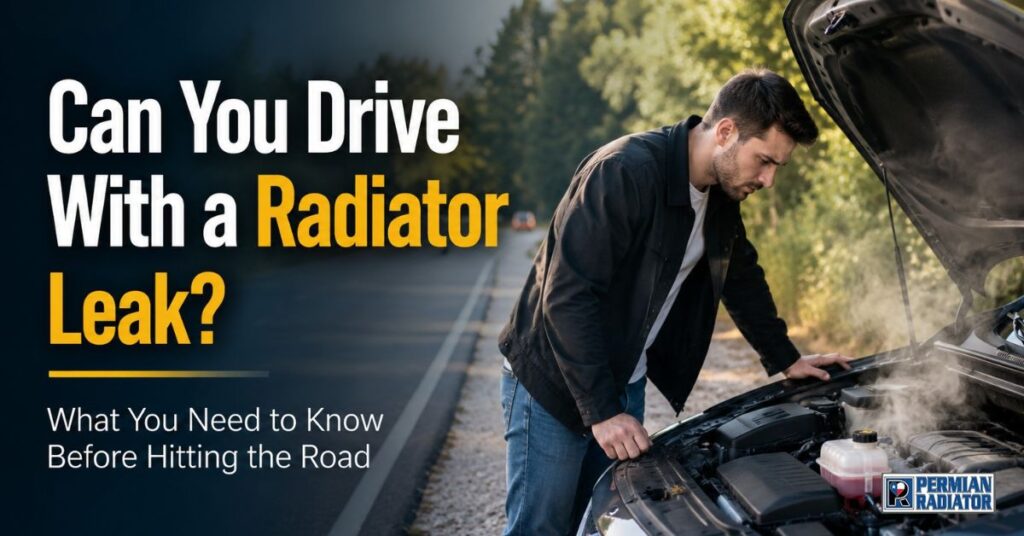
Maybe, for a very short distance, if the leak is small and your temperature gauge stays normal. But driving with a radiator leak is a gamble, and the longer you push it, the more likely you are to cook your engine. If you’re already seeing steam or a climbing temp gauge, stop now.
Most leaks don’t get better on their own. They get worse, usually at the worst possible time. So the real question isn’t just “Can I?” It’s “Should I, and for how long?”
- A small leak with a normal temp gauge: you may make it a few miles to a shop. Watch the gauge like a hawk.
- Steam, a hot gauge, or a warning light: pull over and shut it off. Driving further risks warped heads and cracked blocks.
- Coolant on the ground + sweet smell = classic leak. Don’t ignore it.
- Water is an emergency-only stopgap, not a fix.
- Heavy-duty, diesel, and fleet equipment? The math changes; downtime and engine damage cost far more than a prompt repair.
What a radiator leak actually does to your engine
Your radiator is the heart of the cooling system. Coolant flows through it, sheds heat, and cycles back to keep the engine in a safe temperature range.
When coolant escapes, there’s less of it to do that job. The engine runs hotter. Push it far enough, and metal parts expand past their limits.
That’s when the expensive stuff happens: a warped cylinder head, a blown head gasket, or a cracked block. A leaking radiator might cost a few hundred dollars to sort out. Ignoring it can turn into a teardown.
In short: A radiator leak isn’t a cosmetic problem. It’s the first step toward overheating, and overheating is what wrecks engines.
How long can you actually drive with a radiator leak?
There’s no clean number, and anyone who gives you one is guessing. It depends on a handful of things working together.
Here’s what shortens your window:
- Leak size – a weeping seam buys more time than a split hose
- How hard you’re working the engine – towing, hills, and stop-and-go heat things up fast
- Outside temperature – a 100°F West Texas afternoon is brutal on a low cooling system
- How much coolant is left? Once it’s low, the temperature climbs quickly.
A small leak on a cool day with a full reservoir might let you reach a nearby shop. A real leak on a hot day under load can overheat in minutes.
Expert tip: If you decide to move the vehicle, keep your eyes on the temperature gauge, not the road ahead. The moment the needle climbs toward hot, pull over, shut it down, and let it cool. Don’t try to “make it just a little farther.”
In short: Treat any leak as a “get to a shop now” situation, not a “deal with it next week” one.
When it’s okay to limp to a shop vs. when to stop immediately
This is the decision most people actually need help with. Here’s a simple way to think about it.
Situation | What it usually means | What to do |
Tiny drip, temp gauge normal, no warning light | Slow leak, early stage | You may carefully drive a short distance to a shop, watching the gauge |
Visible puddle, gauge creeping up | Cooling system losing ground | Get it looked at today; don’t take the long way |
Steam from under the hood | The coolant is boiling | Stop. Turn it off. Let it cool before doing anything |
Temp gauge in the red or warning light on | The engine is overheating | Stop immediately – driving further risks major damage |
Heavy-duty truck or equipment leaking under load | Heat builds fast under load | Shut down and call for service; don’t run it hot |
In short, a normal temperature = a short, careful trip is possible. Heat, steam, or a warning light = stop, full stop.
You can also read: Coolant flush signs cost service guide
Is it really the radiator? Leaks, people often mix up
Not every coolant puddle is the radiator itself, and not every leak under your vehicle is even coolant.
A few culprits get confused:
- Radiator hoses or clamps – common and often a cheaper fix than the radiator
- Radiator cap – a worn cap can’t hold pressure, so coolant escapes or boils over
- Header/side tank cracks – stress points where the tank meets the core
- Corrosion – over the years, the core breaks down and weeps from the inside out
On diesels and heavy equipment, there’s another layer. Hydraulic oil coolers, lube oil coolers, and transmission fluid coolers sit in the same neighborhood and can leak, too. An oily film points in one direction; brightly colored coolant points in another. Getting the diagnosis right matters because fixing the wrong part fixes nothing.
Expert tip: Snap a photo of the puddle and the fluid color before you head to a shop. Green, orange, pink, or yellow usually says coolant. A slick, oily patch points toward an oil or transmission cooler instead.
In short, a “radiator leak” is often the symptom. The actual source might be a hose, a cap, or a cooler, and that changes the repair.
Can you just add water and keep going?
In a true roadside emergency, plain water can buy you a little time to reach help. It’s a stopgap, not a solution.
Water alone doesn’t protect against boiling and freezing the way coolant does, and it does nothing for corrosion. The leak is still there, and you’re still losing fluid as you drive.
And one safety rule that matters: never pour cold water onto a hot engine or radiator. The sudden temperature swing can crack components. Let things cool first.
In short: Water gets you off the side of the road. It doesn’t get you out of a repair.
What this looks like for fleets, diesels, and heavy equipment
Here’s where the usual advice falls short. For a daily-driver car, a leak is an inconvenience. For a work truck, a frac unit, a tractor, or a piece of construction equipment, it’s a downtime problem with a dollar figure attached.
An overheated diesel doesn’t just strand a driver. It can sideline a job, miss a delivery window, or put a five- or six-figure engine at risk. The temptation to “run it one more shift” is real, and it’s usually the wrong call.
Honest take: Sometimes a radiator can be repaired, and you save money. Sometimes it’s corroded past the point where a repair would hold, and a replacement is the smarter spend. A good shop tells you which one you’re looking at instead of defaulting to the pricier option.
In short: For commercial and heavy-duty operators, prompt diagnosis isn’t about the radiator; it’s about avoiding downtime and protecting the engine behind it.
How to lower your odds of a roadside leak
You can’t prevent every failure, but a little attention goes a long way.
- Check coolant level regularly, especially before long hauls or heavy work
- Watch for slow drips and stains where you park
- Replace aging hoses and caps before they fail, not after
- Flush the cooling system on schedule to fight corrosion buildup
- Get a pressure test if you suspect a slow leak you can’t pin down
A cooling system inspection catches small problems while they’re still cheap. That’s the whole point of doing it before the gauge ever moves.
In short, most roadside overheating traces back to a small issue someone meant to deal with later.
FAQs
For a very short distance, sometimes, if the leak is small, your temperature gauge stays normal. The safer move is to get it inspected right away, because leaks tend to worsen and lead to overheating.
There's no fixed number. A small leak on a cool day might last a short trip; a serious leak under load can overheat in minutes. Watch your temp gauge and stop if it climbs.
The engine runs hotter as the coolant drops. Sustained overheating can warp the cylinder head, blow the head gasket, or crack the block repairs that cost far more than fixing the original leak.
Common signs include a high or rising temperature gauge, an overheating warning light, colored fluid pooling under the vehicle, a sweet smell, and a steadily dropping coolant level.
It varies. A hose or clamp can be inexpensive, while a corroded core may call for replacement. Catching it early almost always costs less than repairing overheating damage later.
Only as a short-term emergency measure. Water doesn't protect against boiling, freezing, or corrosion, and the leak remains. Get to a shop and have proper coolant restored.
It's risky. Heavy equipment builds heat fast under load, and a damaged diesel engine is far costlier than a radiator repair. Shutting down and arranging service is usually the cheaper decision.
So, can you drive with a radiator leak? Briefly and carefully, maybe, but only with a normal temperature gauge and a short distance to cover. The instant you see steam, a hot gauge, or a warning light, the right move is to stop and protect your engine.
Whether it’s a car that’s leaving spots in the driveway or a piece of equipment you can’t afford to have down, getting an honest diagnosis early is what keeps a small repair from becoming a big one.
Got a leak, an overheating issue, or equipment you need back in service?
Call Permian Radiator in San Angelo, TX, for a free quote or to schedule a cooling system inspection, and let’s find the real problem before it finds your engine.


 ICONIER Digital Marketing Agency