
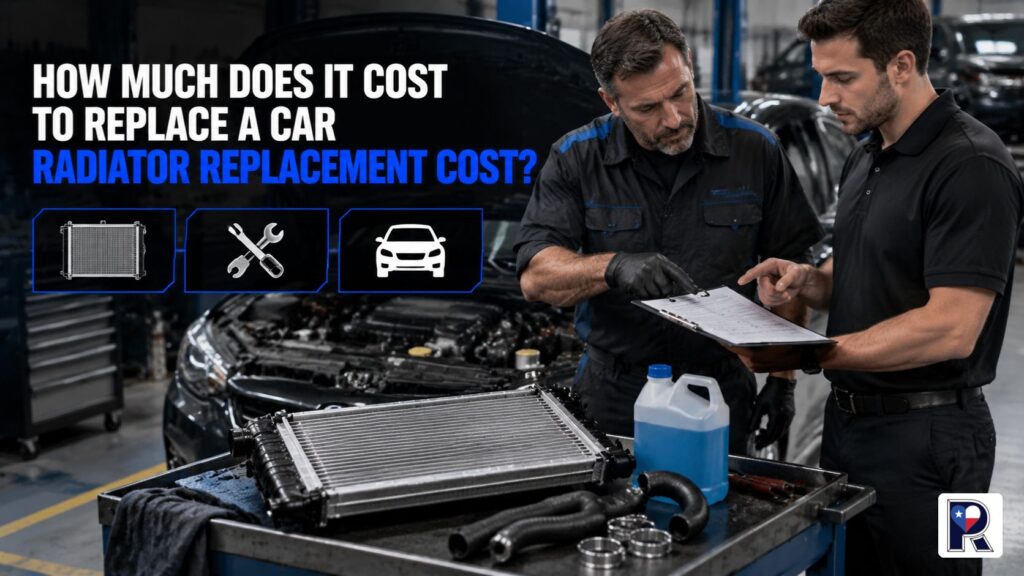
The cost to replace a car radiator commonly falls between about $400 and $1,550 or more for parts and labor, based on current national estimates. That range is broad because a basic sedan with an accessible radiator is a very different job from a diesel truck, luxury vehicle, or model that requires bumper, fan, grille, or cooler-line removal.
Treat online prices as planning figures, not quotes. The only reliable estimate is based on your vehicle’s year, make, model, engine, radiator design, part choice, and actual cooling-system condition.
What is the average cost to replace a car radiator?
For a straightforward passenger vehicle, published estimates often begin around $400. More involved jobs, premium components, and difficult vehicle layouts can push the total beyond $1,000.
A current national parts retailer places a typical installed range around $400–$900, while another national estimator lists an average above $1,300. This difference is exactly why one “average” should not be used to judge every quote.
Typical planning range
Cost category | Broad planning range | What changes the price |
Radiator part | Under $100 to over $1,000 | Vehicle, material, brand, size, availability |
Labor | About $250 to $550 or more | Access, disassembly, cooler lines, local labor rate |
Coolant and supplies | Vehicle-specific | Capacity, coolant formula, clamps, seals |
Typical installed total | About $400 to $1,550+ | Parts, labor, vehicle design, related repairs |
These figures should not be used as a guaranteed local price. Some vehicles will fall below the range, while specialized, diesel, luxury, performance, or heavily packaged models can exceed it.
In short: The vehicle determines the price more than the national average does.
What is included in radiator replacement?
A proper radiator replacement cost may include more than the radiator itself.
The quote should specify whether it covers:
- Diagnosing the source of the leak or overheating
- Removing the old radiator
- Installing the replacement
- New coolant
- Filling and bleeding the cooling system
- Disposal of old coolant
- Checking hoses and clamps
- Reconnecting transmission cooler lines, if fitted
- Testing for leaks after installation
- Verifying fan operation
- Monitoring operating temperature
Do not assume every quote includes all these steps. A low advertised price may cover only the part and basic installation.
Ask whether diagnostic work, coolant, shop supplies, hoses, seals, and post-installation testing are included before approving service.
What affects radiator replacement cost?
Vehicle make, model, and engine
Radiators are designed around a vehicle’s engine, dimensions, transmission, cooling load, and available space.
Two versions of the same model may use different radiators because one has:
- A larger engine
- Turbocharging
- An automatic transmission cooler
- A towing package
- Additional sensors
- A different fan assembly
- A heavy-duty cooling package
Using the vehicle identification number can help confirm the correct part.
Radiator size and construction
A small passenger-car radiator generally costs less than a large truck, diesel, or multi-row unit.
The price may also change based on:
- Aluminum and plastic construction
- Copper-brass construction
- Single-row or multi-row core
- Integrated transmission cooler
- Engine-oil cooler connections
- Sensor ports
- Mounting design
OEM versus aftermarket parts
An OEM radiator is supplied through the vehicle manufacturer’s parts network. It is designed to match the original equipment specifications.
An aftermarket radiator is produced by another manufacturer. Aftermarket quality varies, so the lowest-priced part is not automatically a good value.
Ask the shop:
- What brand is being installed?
- Is it new or used?
- Does it match the original cooling capacity?
- Does it include the correct fittings?
- What parts warranty applies?
- Is labor covered if the part fails?
A properly selected aftermarket component may be reasonable for many vehicles. Some applications are better served by an OEM or vehicle-specific premium component.
Labor and accessibility
The radiator replacement labor cost depends heavily on access.
On some vehicles, the radiator can be removed after disconnecting the hoses, fan, and upper mounts. Others may require removal or repositioning of:
- Bumper cover
- Grille
- Fan shroud
- Electric fan assembly
- Air-intake parts
- Air-conditioning condenser mounts
- Transmission cooler lines
- Oil cooler lines
- Sensors and wiring
Corroded fasteners, seized fittings, and limited engine-bay space can also add labor.
Coolant type and system capacity
The system must be refilled with the correct coolant after replacement. Coolant formulas should not be selected by color alone.
The cost changes with:
- Required coolant specification
- System capacity
- Concentrate versus premixed fluid
- Need for flushing
- Vacuum-filling or bleeding procedure
- Contamination inside the system
A coolant replacement that leaves trapped air can cause temperature fluctuations or overheating, so proper filling is part of the repair.
Related cooling-system damage
A radiator may not be the only failed component.
A quote can increase if inspection finds:
- Cracked or swollen hoses
- Corroded clamps
- Faulty radiator cap
- Failed thermostat
- Inoperative cooling fan
- Damaged fan shroud
- Leaking water pump
- Contaminated coolant
- Damaged mounts
- Transmission-fluid contamination
- Evidence of severe overheating
These parts should not be replaced automatically. The shop should explain what failed, how it was tested, and why it should be repaired during the same visit.
In short: The final bill depends on the radiator, the labor needed to reach it, and any verified problems found around it.
Do you really need a new radiator?
Not every coolant leak requires complete replacement.
A proper cooling system inspection should confirm whether the problem comes from:
- Radiator core
- Plastic tank
- Tank seam
- Upper or lower hose
- Drain plug
- Radiator cap
- Coolant reservoir
- Water pump
- Thermostat housing
- Heater hose
- Transmission cooler connection
A radiator pressure test can help locate a leak that is difficult to see when the engine is cold. It may also prevent you from paying for a radiator when a hose, cap, or fitting is the real problem.
Overheating alone does not prove that the radiator has failed. A thermostat, fan, water pump, low coolant level, trapped air, or internal engine problem may be responsible.
Is it cheaper to repair or replace a radiator?
Repair may cost less if the radiator has a small, accessible defect and the rest of the unit is in sound condition. Replacement is often more sensible when damage affects the radiator’s structure or ability to transfer heat.
Condition | Repair may make sense | Replacement may make sense |
Loose fitting or damaged hose | Yes | No, unless the radiator is also damaged |
Small leak in a serviceable metal unit | Possibly | If corrosion is widespread |
Cracked plastic tank | Limited cases | Often |
Multiple leaks | Rarely | Usually |
Blocked or corroded core | Cleaning or rebuilding may help | If flow cannot be restored |
Damaged mounting frame | Possible on some rebuildable units | If structural damage is severe |
Repeated failed repairs | Unlikely | Usually |
Specialized heavy-duty radiator | Rebuild or recore may be practical | If the core and tanks are beyond repair |
The right radiator repair or replacement decision should be based on the unit’s condition, not on which service has the higher invoice.
What should you look for in a radiator replacement quote?
A useful quote should be specific enough that you can compare it with another shop without guessing.
Look for:
- Confirmed diagnosis: Where is the radiator leaking or failing?
- Part details: New, used, OEM, or aftermarket?
- Labor scope: What must be removed to reach the radiator?
- Coolant details: Is fresh manufacturer-approved coolant included?
- Related parts: Are hoses, clamps, seals, or mounts being replaced?
- Testing: Will the system be pressure-tested after installation?
- Warranty: What is covered, and for how long?
- Additional work: Will the shop contact you before adding repairs?
Be cautious if a quote recommends a radiator without showing evidence of a leak, blockage, crack, or failed test.
Also question a quote that excludes coolant, bleeding, or leak verification. Those are not optional details after opening the cooling system.
Can you save money by replacing the radiator yourself?
DIY replacement can reduce labor charges, but only if you diagnose the problem correctly and complete the refill procedure without introducing air.
The job may require:
- Safe vehicle lifting
- Drain pan and coolant disposal
- Hose-clamp tools
- Line wrenches
- Cooling-fan removal
- Transmission-fluid checks
- Correct coolant
- Vehicle-specific bleeding procedure
A mistake can damage the new radiator, leave a cooler line loose, create an air pocket, or allow the engine to overheat.
DIY is more reasonable on a simple vehicle with an accessible radiator and clear service instructions. It is less practical when the front bodywork, condenser, oil lines, or transmission cooler connections must be disturbed.
Is radiator replacement worth it on an older car?
It depends on the vehicle’s overall condition, not its age alone.
Replacement may still make financial sense when:
- The engine and transmission are healthy
- The vehicle is otherwise dependable
- The radiator is the only major fault
- The installed price is reasonable compared with replacing the vehicle
- Overheating has not caused engine damage
The decision becomes less clear if the vehicle also needs major engine, transmission, suspension, electrical, or safety repairs.
Before approving the work, ask whether the engine shows signs of damage from overheating. A new radiator cannot reverse a damaged head gasket, warped cylinder head, or other internal problem.
What about trucks, fleets, and industrial equipment?
A passenger-car price range should not be applied to commercial trucks, semis, construction machinery, agricultural equipment, or oilfield units.
Heavy-duty replacement pricing depends on:
- Core dimensions
- Radiator material
- Equipment application
- Number of cooling sections
- Parts availability
- Removal requirements
- Shipping or fabrication
- Rebuilding options
- Downtime
- Related hydraulic, transmission, or oil coolers
A radiator rebuild or recore may be more practical for a large or specialized unit that is difficult to source. In other cases, replacement may return the equipment to service faster.
Permian Radiator handles automotive, commercial, industrial, and heavy-duty cooling systems in San Angelo and across the Permian Basin. The team can inspect the unit and explain whether repair, rebuilding, or replacement makes sense.
Frequently Asked Questions
Current national published estimates range from roughly $400 to more than $1,500 for many passenger vehicles. Your actual price depends on the vehicle, radiator, labor access, coolant, part grade, and related damage.
The radiator itself may be costly, but labor can also rise when fans, bodywork, cooler lines, or other components block access. Coolant replacement, system bleeding, and testing add necessary work.
A straightforward job may take a few hours. Tightly packaged vehicles, corroded fittings, integrated coolers, or front-end disassembly can require more time.
Driving is not advisable if coolant is dropping, steam is present, or the temperature is rising. Overheating can cause engine damage quickly.
Usually, yes, when the vehicle is otherwise in good condition and the radiator is the confirmed problem. The decision should account for the vehicle’s value, reliability, and any overheating damage.
Some localized leaks and serviceable metal radiators can be repaired or rebuilt. Multiple leaks, brittle plastic tanks, severe corrosion, and structural damage often point to replacement.
It should include enough correct coolant to refill and bleed the system, but quotes differ. Confirm that coolant, disposal, and post-installation testing are included.
Conclusion
The cost to replace a car radiator can range from a few hundred dollars to well over $1,000 because vehicle design, part quality, labor access, coolant, and related damage vary. A written, vehicle-specific quote is more useful than any single national average.
If your car is leaking coolant, overheating, or showing signs of radiator failure, contact Permian Radiator in San Angelo, TX. The team can inspect and pressure-test the cooling system, explain whether repair or replacement is appropriate, and provide a quote based on the actual vehicle.
Call Permian Radiator or request a free quote before approving a radiator replacement based only on an online average.


 ICONIER Digital Marketing Agency