
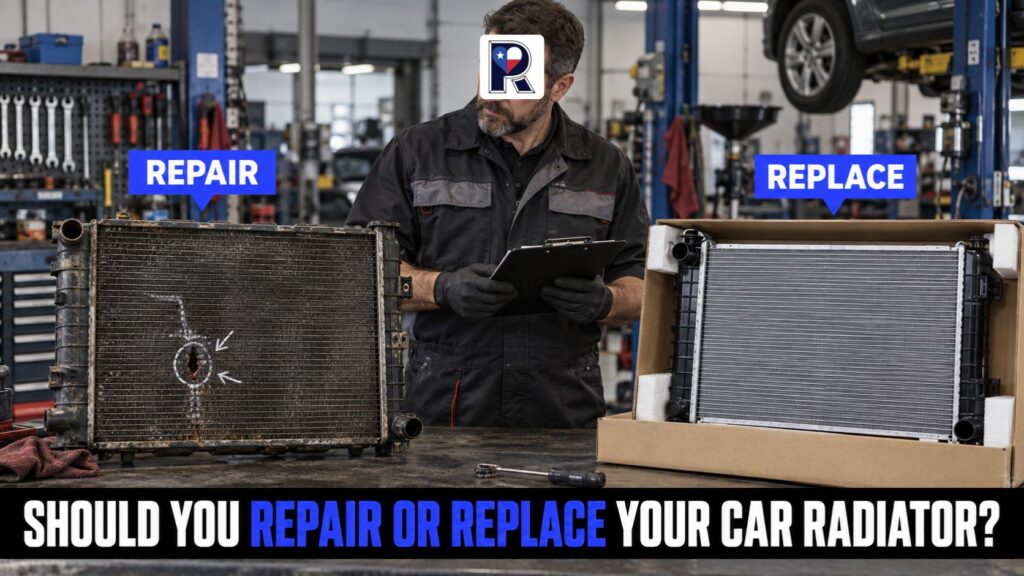
Whether you should repair or replace a car radiator depends on the location of the damage, the amount of corrosion, the radiator’s overall condition, and whether it can hold pressure after service. A small, isolated leak in a sound radiator may be repairable, while a cracked tank, several leaks, severe corrosion, or repeated overheating usually points to replacement or rebuilding.
Do not choose based only on the temperature gauge or the presence of coolant under the car. A leaking hose, failed thermostat, damaged water pump, blocked passage, bad radiator cap, or cooling fan problem can create similar symptoms.
When is car radiator repair a sensible option?
Car radiator repair can make sense when the damage is limited and the rest of the unit remains structurally sound.
Repair may be reasonable when:
- There is one small, accessible leak
- The core has little corrosion
- The tanks are not brittle or distorted
- The mounting points are intact
- The radiator has not been repaired repeatedly
- The unit passes a pressure test after repair
- The radiator is specialized or difficult to replace
- A rebuild or recore can restore the unit properly
Metal radiators may sometimes be repaired through soldering, brazing, tube repair, or recoring. The exact method depends on the radiator’s construction and the location of the damage.
A temporary sealant may slow a minor leak, but it does not prove that the radiator is healthy. Products that circulate through the cooling system can also create problems if they restrict small passages or mask a larger failure.
What should be checked before repairing a radiator?
A repair decision should account for more than the visible leak. A technician may inspect:
- Radiator tanks and seams
- Tubes and fins
- Mounting brackets and rubber cushions
- Upper and lower hoses
- Radiator cap
- Cooling fan operation
- Thermostat and water pump symptoms
- Coolant condition
- Signs of oil or transmission-fluid contamination
In short: Repair is worth considering when the damage is localized and the radiator can still provide reliable cooling after testing.
When does a radiator need replacement?
Radiator replacement is usually the safer route when the unit has widespread deterioration or a repair is unlikely to last.
Replacement may be appropriate when:
- The radiator has multiple leaks
- Plastic tanks are cracked, swollen, or brittle
- Corrosion affects a large part of the core
- Fins are badly bent or missing
- Internal passages are blocked
- The mounting frame is damaged
- The radiator has failed after earlier repairs
- The unit cannot hold pressure
- The vehicle overheated severely
- A suitable replacement is available and fits correctly
A radiator can look acceptable from the outside and still have restricted internal flow. If coolant cannot move through the core properly, the engine may continue to overheat even after a visible leak is fixed.
Repeated repairs also deserve careful thought. Saving money on one repair may not be worthwhile if the radiator is old, corroded, and likely to fail in another location.
In short: Replacement makes more sense when the radiator’s structure or heat-transfer ability is failing, not just one isolated seam.
Repair versus replacement: what is the practical difference?
Condition | More likely repair | More likely replacement |
One small external leak | Yes, if the core is sound | Only if the tank or core is deteriorated |
Cracked plastic tank | Sometimes, depending on design | Often, especially if the plastic is brittle |
Widespread corrosion | Rarely | Usually |
Several leaks | Rarely | Usually |
Blocked internal passages | Sometimes, after professional cleaning | If cleaning cannot restore flow |
Damaged mounting points | Possible rebuild | Replacement may be safer |
Specialized or obsolete radiator | Rebuild or recore may help | Replacement if a reliable unit is available |
Repeated overheating | Requires deeper diagnosis | Replacement if the radiator is the cause |
Recent radiator with isolated damage | Often worth repairing | Not automatically necessary |
The lowest initial price is not always the lowest total cost. A repair that fails soon after installation can mean another removal, another coolant refill, towing, and more downtime.
How do you know if your radiator is actually the problem?
Before approving radiator replacement, ask for a proper diagnosis. A cooling system inspection may include a visual check, coolant assessment, pressure test, and review of the vehicle’s overheating pattern.
A radiator pressure test can reveal leaks that are difficult to see when the engine is cold. It can also help separate a radiator leak from a hose, cap, fitting, reservoir, or another cooling-system component.
The inspection should consider:
- Where coolant is escaping: The radiator, hose, water pump, thermostat housing, or another component.
- When the overheating happens: At idle, in traffic, under load, on the highway, or immediately after startup.
- Whether coolant is circulating: Restricted flow can point to blockage or another internal problem.
- Whether the fan operates: A fan issue can cause overheating even when the radiator itself is sound.
- Whether fluids are mixing: Oil in coolant or coolant in transmission fluid requires prompt attention.
- Whether the radiator holds pressure: A failed test supports repair or replacement, depending on the damage.
A car that overheats only at low speed may have a fan or airflow problem. A car that overheats under load may have restricted flow, a failing pump, a blocked radiator, or another engine issue.
In short: A pressure test and system inspection prevent you from paying for a radiator when another part is causing the symptoms.
Is it cheaper to repair or replace a radiator?
A repair may cost less when the damage is small and the radiator is otherwise in good shape. Replacement may offer better value when the radiator is old, corroded, difficult to access, or likely to develop another leak.
The total decision should include:
- Parts availability
- Labor time
- Whether the radiator must be removed for repair
- Coolant and flushing requirements
- Condition of hoses, cap, and mounts
- Risk of another failure
- Vehicle downtime
- Whether the vehicle is used for work or transportation
For a personal car, a repair may be sensible if the unit is structurally sound. For a fleet truck or work vehicle, reliability and downtime may matter more than the cheapest first invoice.
Do not assume that every new radiator is automatically the right choice. The replacement must match the vehicle’s engine, transmission setup, mounting points, hose connections, and cooling requirements.
Can a cracked radiator be repaired?
Sometimes. A small crack in a repairable area may be addressed through tank service, soldering, brazing, or rebuilding, depending on the radiator’s design.
Replacement is more likely when the crack is in a brittle plastic tank, the surrounding material is deteriorated, or the radiator has additional corrosion and leaks. A repair should be followed by testing to confirm that the unit can withstand normal pressure and operating temperatures.
A sealant or epoxy may be useful as a temporary measure in limited situations, but it should not be treated as a long-term answer for a vehicle that is overheating or losing coolant quickly.
What if the radiator looks fine but the engine still overheats?
A radiator is only one part of the cooling system. Engine overheating can also result from:
- A failed thermostat
- Faulty water pump
- Inoperative cooling fan
- Damaged fan clutch
- Collapsed or restricted hose
- Faulty radiator cap
- Air trapped in the system
- Blocked radiator passages
- Low coolant caused by another coolant leak
- Internal engine problems
A coolant flush may help when contamination or scale is restricting flow, but flushing will not fix a cracked tank or damaged core. The correct service depends on what testing finds.
If the temperature gauge reaches the danger zone, steam appears, or coolant is rapidly escaping, shut the engine off safely. Continuing to drive can turn a cooling-system problem into major engine damage.
When do heavy-duty and commercial radiators need a different decision?
Passenger-car advice does not always apply to a heavy-duty truck, diesel, construction machine, agricultural unit, or oilfield equipment.
These systems may operate under high loads and may include:
- Large radiator cores
- Charge-air coolers
- Hydraulic oil coolers
- Lube oil coolers
- Transmission fluid coolers
- Specialized mounting systems
- Multiple fluid circuits
A radiator that appears to be the problem may be connected to a wider heat-management issue. For example, a restricted oil cooler or damaged transmission cooler can create abnormal temperatures even when the engine radiator is not the only failed component.
In these cases, heavy-duty radiator repair, rebuilding, cleaning, pressure testing, or replacement should be based on the equipment’s operating demands and the cost of downtime.
What does Permian Radiator inspect before recommending a solution?
Permian Radiator serves San Angelo and the wider Permian Basin with automotive, commercial, industrial, and heavy-duty cooling-system services.
Depending on the application, the evaluation may include:
- Visual inspection of the radiator and related components
- Cooling-system cleaning or flushing
- Pressure testing
- Checking tanks, tubes, fins, fittings, and mounts
- Identifying oil or coolant cross-contamination
- Reviewing repeated overheating or leak history
- Assessing whether repair, rebuilding, or replacement is practical
The goal is to match the service to the unit’s actual condition. That may mean repairing one section, recoring or rebuilding the radiator, replacing it, or identifying another component that caused the symptom.
In short: A professional inspection gives you a decision based on evidence instead of guessing from a puddle or temperature reading.
Frequently Asked Questions
Repair may work for a localized leak in a structurally sound radiator. Replacement is usually more appropriate for multiple leaks, severe corrosion, brittle tanks, blocked passages, or a radiator that cannot hold pressure.
Common signs include coolant loss, visible leaks, overheating, corrosion, repeated low coolant, steam, and residue around the radiator. These signs can also come from hoses, the water pump, thermostat, fan, or another component, so testing is useful.
Repair often has a lower initial cost when the damage is isolated. Replacement may be more economical over time when the radiator is old, damaged in several areas, or likely to fail again.
There is no safe universal distance. If the temperature rises or coolant loss is significant, stop driving. Even a short trip with an overheating engine can cause serious damage.
Some radiators can be rebuilt or recored when the tanks, frame, and other major parts are usable. This is more common with specialized, heavy-duty, or difficult-to-source units.
A flush may help remove contamination or restricted coolant flow. It will not repair a cracked tank, leaking seam, damaged core, or badly corroded radiator.
Common causes include age, corrosion, contaminated coolant, physical impact, vibration, repeated overheating, damaged mounts, and excessive pressure from another cooling-system problem.
Conclusion
The decision to repair or replace a car radiator should come after checking the leak, radiator material, corrosion, pressure-test results, repair history, and the vehicle’s operating demands. A small isolated fault may be repairable, while structural damage or repeated overheating usually calls for replacement or rebuilding.
If your vehicle is losing coolant, running hot, or showing signs of radiator failure, contact Permian Radiator in San Angelo, TX. The team provides car radiator repair, replacement, rebuilding, cleaning, flushing, and pressure testing for automotive, commercial, industrial, and heavy-duty applications.
Call Permian Radiator or request a free quote to find out whether your radiator needs a repair, rebuild, or replacement.


 ICONIER Digital Marketing Agency