
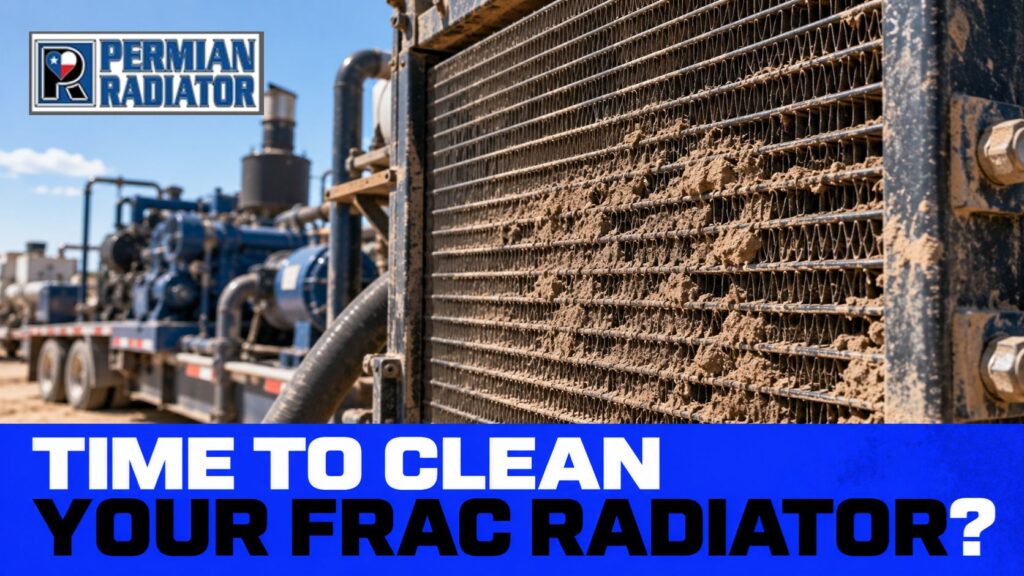
There is no single safe calendar interval for frac pump radiator cleaning in the Permian Basin. A radiator should be inspected frequently and cleaned whenever dust, oily debris, packed material, or temperature trends show that airflow and heat transfer are being restricted. Equipment working on dusty pads may need attention far more often than equipment operating in cleaner conditions.
The useful question is not, “Has it been 30, 60, or 90 days?”
It is, “Is this cooling pack still moving enough air to control temperature at the load this pump is running?”
Why Permian Basin Radiators Need Closer Attention
Oilfield equipment in West Texas can encounter fine dust, caliche, road debris, oil mist, and material kicked up by constant vehicle movement.
Radiator fins are designed with narrow air passages because a large amount of surface area is needed to transfer heat.
That same design gives contamination plenty of places to collect.
Over time, buildup can reduce airflow through:
- The radiator
- Charge air cooler
- Hydraulic cooler
- Transmission cooler
- Other stacked heat exchangers
This is why Permian Basin radiator cleaning should be based on actual operating conditions.
In short: A calendar can remind you to inspect the radiator. The condition of the cooling pack should determine whether it needs cleaning.
How Often Should a Frac Pump Radiator Be Cleaned?
For how often a frac pump radiator should be cleaned, start with the manufacturer’s preventive-maintenance requirements and then shorten the inspection or cleaning interval when operating conditions justify it.
Factors that may require more frequent cleaning include:
- Heavy airborne dust
- Frequent travel on unpaved roads
- Oily residue on the core
- Long high-load operating periods
- Hot ambient conditions
- Restricted space around stacked coolers
- A history of rising coolant temperatures
- Rapid debris buildup after previous cleanings
Two pumps with the same radiator can need different maintenance intervals if they work in different locations or duty cycles.
Build an interval from your own equipment history
Record:
- Date of inspection
- Date of cleaning
- Type of contamination found
- Coolant temperature before cleaning
- Coolant temperature after cleaning
- Fan condition
- Any damaged fins
- Whether other coolers were blocked
- Operating hours since the previous service
After several service cycles, patterns become easier to see.
For fleet maintenance, that information is far more valuable than copying another operator’s cleaning interval.
How Do You Know a Radiator Is Clogged?
A dirty radiator does not always look completely plugged.
Possible signs of radiator airflow restriction include:
- Coolant temperature rising as equipment load increases
- Equipment running hotter than its previous normal baseline
- Temperature improving when load is reduced
- Visible dirt packed between fins
- Debris trapped between cooling-stack components
- Cooling fan running harder or more often
- Hot spots across the radiator
- Repeated overheating despite correct coolant level
None of those signs proves the radiator is the only problem.
The fan, coolant circulation, thermostat, water pump, radiator cap, hydraulic system, and engine load may also affect temperature.
In short: Treat a temperature increase as evidence to inspect the system, not automatic proof that the radiator needs replacement.
Inspect Between the Coolers
This is one of the easiest maintenance points to miss.
Many heavy-duty machines use several heat exchangers arranged in a cooling stack.
The front surface may look acceptable while dust and oily debris are trapped between the charge air cooler and radiator or between another cooler and the radiator core.
During cooling stack inspection, look into the complete airflow path where access allows.
A restriction in the component ahead of the radiator can reduce airflow through everything behind it.
Why Oily Debris Is Different From Dry Dust
Dry loose dust and oily contamination should not automatically be cleaned the same way.
Oil on the core acts like adhesive.
Dust sticks to it, creating a layer that can become harder to remove.
When oily material is found, look for the source before simply cleaning the radiator.
Possible sources include:
- Hydraulic hose leaks
- Cooler leaks
- Engine-oil leaks
- Loose fittings
- Seepage from nearby components
Otherwise, the clean core may become dirty again quickly.
Should You Pressure Wash a Frac Pump Radiator?
Only when the equipment manufacturer and radiator design permit the method, and the pressure is controlled appropriately.
High-pressure water used too close to a radiator can bend fins.
Bent fins reduce the open area available for airflow and can leave a radiator looking cleaner while cooling worse.
Cleaning should also avoid driving contamination deeper into a stacked cooling pack.
Depending on the equipment and material being removed, a shop may use controlled air, appropriate washing methods, chemical cleaning, disassembly, or another cleaning process.
The correct method depends on:
- Radiator material
- Fin condition
- Contaminant type
- Core depth
- Cooling-stack arrangement
- Access
- Manufacturer guidance
When Cleaning Will Not Fix the Problem
A radiator is not automatically serviceable just because contamination can be removed.
Heavy-duty radiator cleaning will not correct:
- Cracked tubes
- Failing seams
- Severe corrosion
- Internal core restrictions that cleaning cannot remove
- Damaged tanks
- Structural failure
- Failed fan components
- A bad water pump
- Incorrect coolant flow
- Excessive heat produced elsewhere
If cleaning restores airflow but temperature still climbs, continue the diagnosis.
Do not keep cleaning the same radiator hoping a mechanical problem will disappear.
Can a Dirty Radiator Cause Frac Equipment to Overheat?
Yes.
For ” Can a dirty radiator cause frac equipment to overheat, the reason is straightforward.
The radiator needs airflow across its fins to transfer heat from the coolant to the surrounding air. If contamination blocks enough of that airflow, cooling capacity falls.
The effect may appear most clearly during heavy pump operation.
At idle, the cooling system may keep up.
Under load, heat production rises, and the reduced cooling capacity becomes obvious.
That load-only pattern deserves inspection before the machine is returned to normal operation.
Cleaning Frequency vs. Inspection Frequency
These are not the same thing.
You may inspect frequently without cleaning every time.
A useful maintenance program separates the two:
Maintenance task | Purpose | When it makes sense |
Visual inspection | Find contamination or damage early | Regular preventive maintenance |
Temperature trend review | Detect declining cooling performance | During normal operating review |
External cleaning | Restore airflow through dirty fins | When buildup becomes significant |
Internal cleaning or flushing | Address internal contamination | When testing or fluid condition supports it |
Pressure testing | Find leaks or confirm system integrity | When leakage is suspected |
Repair/recore | Correct physical core damage | After inspection confirms damage |
Replacement | Replace a radiator no longer worth rebuilding | When condition, availability, or downtime favors replacement |
In short: Inspect on a routine basis. Clean when contamination is affecting, or is likely to affect, airflow and heat transfer.
What Should Maintenance Managers Track?
For frac pump radiator maintenance, a basic record can include:
- Unit number
- Equipment hours
- Inspection date
- Cleaning date
- Temperature readings
- Ambient conditions
- Type of debris
- Leak findings
- Fan findings
- Repair history
- Photos of the core
Photos are particularly useful.
A picture taken after each inspection can show whether contamination is building faster than it did during the previous service interval.
When Should a Radiator Shop Inspect the Unit?
Consider professional inspection when:
- The equipment continues to overheat after external cleaning
- Coolant is leaking
- The core is physically damaged
- Fins are badly deteriorated
- Internal restriction is suspected
- The radiator has been repaired repeatedly
- The complete cooling stack needs to be evaluated
- The operator cannot safely access or clean the component
A radiator shop can help determine whether the problem calls for cleaning, pressure testing, repair, recoring, rebuilding, or replacement.
That distinction helps prevent unnecessary parts replacement.
Frequently Asked Questions
For why do Permian Basin radiators clog quickly, the operating environment is a major factor.
Fine West Texas dust, unpaved locations, traffic, oil residue, and continuous field operation can increase how quickly material collects on cooling fins.
For how do you know a radiator is clogged inspect for debris, reduced airflow, rising temperature under load, abnormal temperature patterns, and contamination between stacked coolers.
Testing is needed before assuming the radiator is the only cause.
Yes. Restricted airflow reduces the radiator’s ability to reject heat, especially when equipment load increases.
Only when the radiator design and manufacturer’s guidance permit it.
Improper pressure or nozzle distance can damage fins.
No.
Fan problems, low coolant, coolant-flow restrictions, water-pump issues, thermostat faults, leaks, excessive equipment load, and other cooling circuits can produce similar symptoms.
Not necessarily.
Determine why contamination is returning first. An oil leak, airflow problem, equipment environment, cleaning method, or cooling-stack design may be contributing.
Set the Cleaning Interval From What the Equipment Tells You
The right frac pump radiator cleaning schedule is based on the machine, not a generic number.
Use the manufacturer’s maintenance requirements as the starting point, then adjust inspection and cleaning frequency around actual contamination, temperature trends, operating load, and service history.
Permian Radiator provides heavy-duty, commercial, and industrial radiator services for equipment operators in San Angelo, TX and across the Permian Basin.
If a frac pump is running hotter, the cooling pack is heavily contaminated, or normal cleaning is no longer solving the problem, call Permian Radiator to schedule an inspection or request a quote.


 ICONIER Digital Marketing Agency