
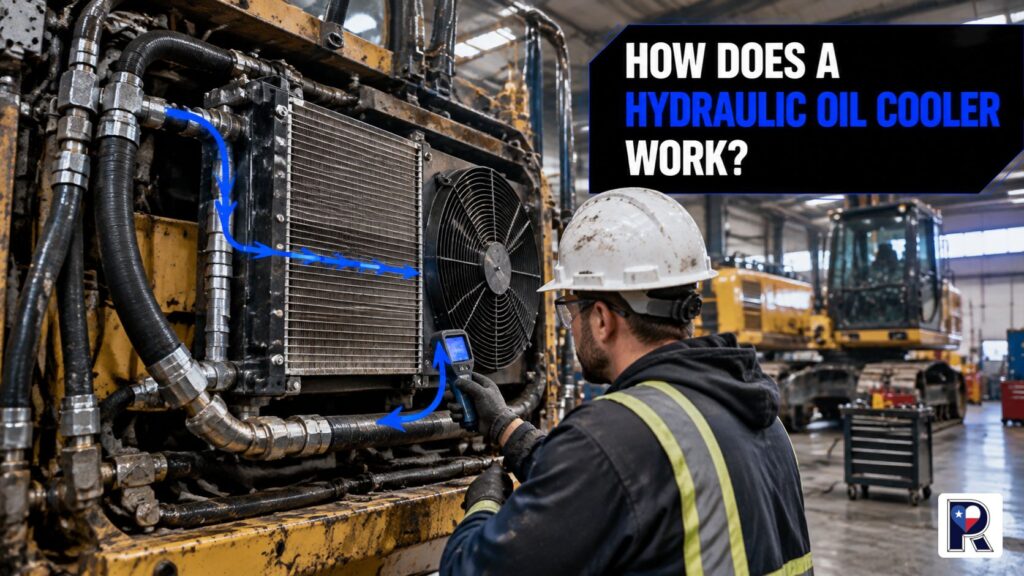
A hydraulic oil cooler removes unwanted heat from circulating hydraulic fluid. Hot oil enters a heat exchanger, heat passes through the cooler’s metal surfaces, and moving air or water carries that heat away. The cooler oil then returns to the reservoir or hydraulic circuit.
The unit does not need to make the oil cold. Its job is to help hold the hydraulic fluid temperature within the operating range specified by the equipment manufacturer.
What does a hydraulic oil cooler do?
Hydraulic equipment turns engine or motor power into movement. Pumps, control valves, motors, cylinders, hoses, and fittings all contribute some heat because no hydraulic system transfers energy without losses.
Common heat sources include:
- Fluid moving through restricted passages
- Pressure dropping across control or relief valves
- Internal leakage inside worn pumps or motors
- Mechanical and fluid friction
- Undersized hoses, blocked filters, or poor circuit design
- Continuous operation near the machine’s load limit
A cooler rejects part of that lost energy so the system can reach a manageable heat balance. That balance occurs when the cooling system releases heat at roughly the same rate the hydraulic circuit produces it.
As oil gets hotter, it normally becomes thinner. Oil that is too thin may not maintain the lubricating film and internal sealing clearances that pumps, valves, and motors need.
In short: The hydraulic cooling system controls heat that the machine cannot avoid producing during normal work.
How does a hydraulic oil cooler work? Step by step
The exact circuit varies by machine, but the cooling process usually follows six stages.
- The oil absorbs heat.
Hydraulic fluid picks up heat as it moves through pumps, valves, actuators, and lines. - Hot oil reaches the cooler.
Depending on the design, the oil may enter from a return line or from a separate cooling loop with its own circulation pump. - The cooler core spreads the heat.
Oil flows through tubes, passages, or stacked plates. These metal surfaces provide a large area for heat transfer. - Air or water receives the heat.
A fan may pull outside air across the cooler fins, or a separate water circuit may flow past the oil passages. The two fluids remain separated by the metal core. - Cooled oil leaves the unit.
The oil returns to the reservoir or continues through the circuit, depending on the equipment design. - A bypass may manage cold starts.
Cold oil is thicker and harder to push through a cooler. If the system has an oil cooler bypass valve, it may temporarily route oil around the core until viscosity and pressure return to the intended range.
Air-cooled units transfer heat from the oil into ambient air, while liquid-cooled designs transfer it into a separate coolant circuit.
In short: Oil carries heat to the cooler, the core transfers it through metal, and air or water takes the heat away.
What parts are inside a hydraulic oil cooler?
A typical cooler assembly may contain:
- Core: The tubes, plates, or passages that carry oil
- Fins: Thin metal surfaces that increase the area exposed to air
- Inlet and outlet ports: Connections that route oil through the core
- Fan and motor: Components that create airflow on an air-cooled oil cooler
- Bypass valve: A pressure-sensitive route around the core, if fitted
- Temperature switch or controller: Turns a fan on and off on some systems
- Mounts and guards: Protect the assembly from vibration and impact
Not every cooler includes every component. Some machines place the fan, bypass valve, or temperature control elsewhere in the circuit.
What are the main types of hydraulic oil coolers?
The two common designs are air-cooled and water-cooled.
Cooler type | How it removes heat | Common applications | What to watch |
Air-cooled oil cooler | A fan moves ambient air across a finned core | Mobile equipment, agricultural machinery, construction equipment and outdoor installations | Dust-packed fins, damaged fan blades, failed motors and recirculating hot air |
Water-cooled oil cooler | Oil and water move through separate passages divided by metal plates or tubes | Industrial systems, plants and machines with an available cooling-water circuit | Scale, restricted water flow, corrosion and internal cross-leaks |
An air-cooled design is relatively self-contained, but its performance depends on clean fins and access to cooler outside air. A water-cooled oil cooler can fit into a smaller space, but it needs an adequate water supply and clean internal passages.
Neither design is automatically right for every machine. Operating environment, heat load, available space, water quality, airflow, oil flow, and duty cycle all matter.
In short: Air-cooled units are practical where clean airflow is available. Water-cooled units suit facilities that can provide suitable cooling water.
Where is the cooler installed in a hydraulic system?
Many coolers are placed in the return line, where oil travels back toward the reservoir. This location usually exposes the core to lower pressure than the pump’s main pressure line, but the cooler still needs to handle the return flow and any pressure surges allowed by the system design.
An offline or “kidney-loop” cooler uses a separate pump to draw oil from the reservoir, move it through the cooler, and return it to the tank. This arrangement allows cooling to continue independently of the main machine cycle.
A cooler should not be added to an arbitrary line. Excessive backpressure can affect seals and component operation, while an undersized line or core can increase hydraulic cooler pressure drop.
How is a hydraulic oil cooler sized?
A cooler should be selected by the heat it must reject, not just the engine size or pump horsepower. Accurate hydraulic oil cooler sizing typically considers:
- Expected heat load
- Oil flow through the cooler
- Oil temperature entering the core
- Ambient air or cooling-water temperature
- Desired outlet temperature
- Oil type and viscosity
- Allowable pressure drop
- Fan voltage or hydraulic motor requirements
- Continuous versus intermittent operation
- Dust, debris, altitude, and available airflow
Manufacturers publish performance curves so a cooler can be matched to actual operating conditions. Parker’s product guidance likewise notes that correct selection depends on precise system sizing and calculation.
Installing a larger unit without checking flow and pressure is not a reliable shortcut. The cooler, fan, hoses, bypass arrangement, and mounting location must work as one system.
In short: Size the cooler for measurable heat load, oil flow, temperature conditions, and pressure limits.
How do you know if a hydraulic oil cooler is not working?
The first clue is often a change from the machine’s normal operating pattern. A system that starts running hotter, slows down after warming up, or repeatedly triggers a temperature warning deserves inspection.
Symptom | Possible cause | First check |
Temperature climbs during normal work | Blocked fins, low airflow, insufficient water flow or excess system heat | Inspect airflow or cooling-water supply |
Fan does not operate | Fuse, relay, wiring, switch, motor or hydraulic fan-drive fault | Verify the fan command and power source |
Oil leaks around the cooler | Loose fitting, damaged hose, cracked joint or core damage | Clean the area and locate the exact leak |
Cooler inlet is hot but outlet changes little | Poor airflow, internal fouling, bypass stuck open or excessive oil flow | Compare inlet and outlet temperatures safely |
Oil temperature rises after recent service | Wrong hose routing, closed valve, trapped air or incorrect fan rotation | Recheck the work against the service manual |
Cooler creates excessive backpressure | Internal restriction, cold high-viscosity oil or undersized core | Measure pressure before and after the cooler |
High oil temperature does not automatically prove that the cooler has failed. A relief valve held open, pump wear, internal cylinder leakage, a restricted filter, or undersized plumbing can produce heat faster than a working cooler can remove it.
That distinction matters. Replacing the cooler without finding the heat source may leave the machine with the same overheating problem.
In short: Confirm airflow, fluid flow, fan operation, pressure drop, bypass function, and system heat generation before replacing the core.
Practical hydraulic oil cooler maintenance
Before touching the system, shut down the machine, follow its lockout procedure, allow the oil to cool, and release stored hydraulic pressure. Hot oil under pressure can cause serious injury.
Routine checks should include:
- Remove dirt, seeds, insects, and oily buildup from air-side fins
- Straighten minor fin damage only with the proper fin tool
- Check that the fan turns in the correct direction
- Inspect hoses, clamps, fittings, and mounts
- Look for oil staining around seams and connections
- Check water-side flow and scaling on liquid-cooled units
- Record normal inlet and outlet temperatures for comparison
- Follow the equipment manufacturer’s oil and filter schedule
Use low-pressure cleaning methods suited to the core. A concentrated pressure-washer stream can fold delicate fins and reduce airflow.
For equipment working around caliche dust, chaff, or oilfield debris, visual inspection may be needed more often than a generic calendar schedule suggests. Maintenance should follow actual operating conditions.
When does the cooler need professional testing?
Call for testing when a leak cannot be traced visually, operating temperature keeps rising after cleaning, pressure drop is abnormal, or oil and coolant may be mixing.
A repair shop may use controlled pressure testing to locate leaks that are difficult to see. Cleaning, flow checks, and inspection can then determine whether the core is serviceable.
Can a hydraulic oil cooler be repaired?
Sometimes. Loose connections, damaged hoses, some fan problems, external contamination, and certain serviceable core leaks may be repairable.
Replacement may make more sense when the core has widespread corrosion, crushed passages, severe deformation, repeated leaks, or an internal failure that cannot be repaired safely. The decision should be based on the cooler’s construction, condition, application, and test results.
Permian Radiator provides hydraulic oil cooler repair San Angelo TX equipment owners can use for inspection, cleaning, pressure testing, and repair evaluation. The shop also works with commercial, industrial, oilfield, and heavy-duty cooling equipment across the Permian Basin.
Expert tips for avoiding repeat overheating
- Record temperatures under comparable loads instead of judging the machine after one unusually hard cycle.
- Inspect the space in front of and behind an air cooler. A clean core still performs poorly if hot discharge air is pulled back through it.
- Do not remove or permanently defeat a bypass valve to solve a temperature complaint.
- Check the hydraulic system for heat generation before assuming the cooler is undersized.
- Match replacement oil to the viscosity grade and specification listed by the equipment manufacturer.
- After a cooler failure, inspect the circuit for contamination before returning the machine to service.
Frequently Asked Questions
Hydraulic oil gets hot because pumps, valves, motors, cylinders, lines, and restrictions convert part of the machine’s input energy into heat. Wear, internal leakage, blocked filters, and prolonged relief-valve operation can increase that heat.
Excess heat makes the oil thinner and can reduce its ability to lubricate and seal component clearances. Persistent overheating may also shorten the useful life of oil, hoses, seals, pumps, and other hydraulic parts.
Not always. Some systems circulate oil continuously, while others use a temperature switch, fan controller, thermostat, or separate cooling loop that operates only when needed.
Yes. Dirt and oily debris block air from moving across the fin surfaces. The fan may still run, but the cooler cannot transfer heat effectively when airflow through the core is restricted.
Yes. A cooler that cannot reject the system’s heat load may allow temperatures to climb during sustained operation. Before increasing cooler capacity, check for faults that may be producing abnormal heat.
A damaged liquid-cooled heat exchanger can allow fluids to cross between circuits, depending on its design and the pressure on each side. Suspected internal leakage calls for prompt shutdown and controlled pressure testing.
There is no useful schedule for every machine. Inspect it according to the manufacturer’s instructions and the work environment; equipment exposed to heavy dust, chaff, or oily debris generally needs closer monitoring.
Keep the heat problem from becoming a hydraulic failure
A hydraulic oil cooler works by carrying hot oil through a metal heat exchanger and releasing that heat into air or water. When temperatures rise, the right response is to check both sides of the problem: whether the cooler can release heat and whether the hydraulic circuit is producing more heat than it should.
If your equipment is overheating, leaking, or losing performance when warm, contact Permian Radiator. Call now, request a free quote, or schedule industrial oil cooler service San Angelo operators can use to identify the fault and choose a sensible repair path.


 ICONIER Digital Marketing Agency