
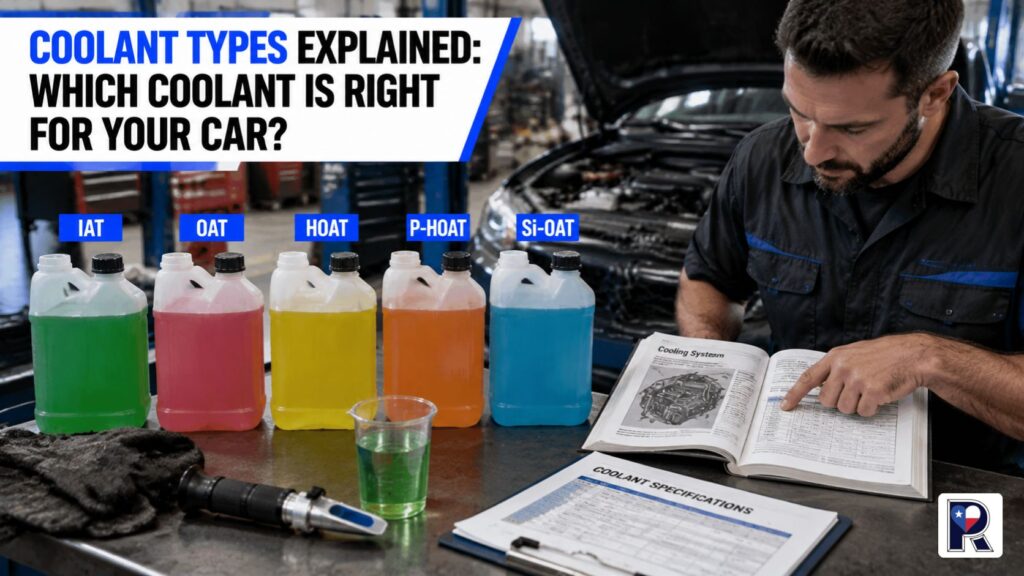
The right coolant is the product that meets the exact specification listed for your car’s year, make, model, and engine. Do not choose between coolant types by color alone, and do not assume every product labeled “universal” is approved for your vehicle. Check the owner’s manual or manufacturer service information, then confirm that specification on the coolant container.
What does engine coolant do?
Engine coolant, commonly called antifreeze, circulates through the engine and radiator to control temperature. It absorbs engine heat, carries it to the radiator, and helps protect the system when outside temperatures fall below freezing.
Coolant also contains additives that protect metal, seals, gaskets, and water-pump components. The additive package is where many coolant formulas differ.
Plain water can transfer heat, but it does not provide the same freeze, boil, corrosion, and component protection as the manufacturer-approved coolant mixture.
In short: Coolant manages heat while protecting the materials inside the cooling system. Its job goes well beyond preventing freezing.
The main coolant types explained
IAT, OAT, and HOAT describe the corrosion-inhibitor technology used in a coolant. They are broad families, not interchangeable product specifications.
Coolant family | What the abbreviation means | General description | Selection warning |
IAT coolant | Inorganic Additive Technology | Uses traditional inorganic corrosion inhibitors and is found in many older applications | Do not assume every older vehicle uses the same green formula |
OAT coolant | Organic Acid Technology | Uses organic-acid inhibitors and is common in many later-model vehicles | Different OAT products may meet different manufacturer specifications |
HOAT coolant | Hybrid Organic Acid Technology | Combines organic-acid inhibitors with selected inorganic additives | HOAT is a broad category, not one universal formula |
P-HOAT coolant | Phosphated Hybrid Organic Acid Technology | A hybrid formula that includes phosphate-based protection | Common in some applications, but suitability must be confirmed by specification |
Si-OAT coolant | Silicated Organic Acid Technology | Combines organic-acid technology with controlled silicate protection | Used in certain European and other applications; approval varies |
NOAT or heavy-duty ELC | Nitrited Organic Acid Technology or Extended Life Coolant | Designed for certain diesel and heavy-duty cooling systems | Passenger-car coolant should not be substituted without manufacturer approval |
IAT coolant
IAT coolant is often associated with older vehicles and the traditional green antifreeze many drivers remember. It uses inorganic additives such as silicates or phosphates to protect cooling-system metals.
The phrase “traditional green” is only a general description. A green product on the shelf is not automatically the correct IAT formula for an older car.
OAT coolant
OAT coolant uses organic-acid inhibitors to control corrosion. It is used in many modern vehicles and often has a longer manufacturer-specified service interval than older conventional formulas.
Not all OAT products carry the same approvals. An OAT coolant intended for one vehicle family may not meet the specification required by another.
HOAT coolant
HOAT coolant combines organic-acid technology with selected inorganic inhibitors. The added chemistry may include silicates, phosphates, or other additives depending on the application.
This category includes several formulas that should not be treated as identical. Labels such as P-HOAT and Si-OAT provide more detail, but the manufacturer specification is still the deciding factor.
Heavy-duty and diesel coolants
Some commercial trucks and diesel equipment use extended-life formulas, nitrited coolants, supplemental coolant additives, or coolant filters. These systems may have maintenance requirements that do not apply to passenger cars.
Fleet operators should follow the engine or equipment manufacturer’s coolant program. Adding an automotive product based on color can disturb the intended additive balance.
In short: IAT, OAT, and HOAT help describe coolant chemistry. They do not replace the vehicle-specific approval printed in the manual and on the product label.
What coolant does my car need?
Start with the owner’s manual. Look under cooling-system capacities, fluids, maintenance, or technical specifications.
The manual may provide:
- A manufacturer coolant name
- An engineering or performance specification
- Required coolant chemistry
- Mixing ratio
- Cooling-system capacity
- Replacement interval
- Special bleeding or filling instructions
If the manual lists a specification code, choose a product that states it meets or is approved to that exact specification. A vague statement such as “works with most cars” is not the same as a documented approval.
Manufacturer guidance can be strict. One automaker’s technical position states that no single coolant has been proven for every vehicle and warns that mixing unapproved products may damage the cooling system.
Use the full vehicle information
Coolant requirements can change within the same vehicle line. Confirm:
- Model year
- Make and model
- Engine size or engine code
- Gasoline, diesel, hybrid, or electric powertrain
- Country or production market when relevant
- Manufacturer coolant specification
A parts catalog or fluid finder can help narrow the choice, but verify its recommendation against the owner’s manual.
Read the container carefully
Do not stop at the front label. Check the back for formal specifications, approvals, dilution instructions, and application notes.
Phrases such as “recommended for,” “compatible with,” “meets,” and “approved” may not mean exactly the same thing. When the vehicle requires a formal approval, look for that approval rather than relying on similar-sounding marketing language.
Consider what is already in the system
If the cooling system contains a known, approved fluid, use a compatible product that meets the same requirement. If the existing coolant cannot be identified, guessing creates unnecessary risk.
An inspection or controlled coolant replacement may be a better choice than mixing an unknown fluid with a new one.
In short: Match the exact coolant specification, not a general coolant family, bottle color, or brand claim.
Does coolant color tell you which type to buy?
No. Coolant color is a dye choice, not a regulated technical standard.
Green is often associated with IAT, orange with some OAT formulas, and yellow, pink, blue, purple, or turquoise with various extended-life and hybrid products. Those associations are inconsistent across manufacturers.
Two coolants can share a color while using different additive chemistry. Two versions of a similar chemistry can also be dyed different colors.
Manufacturer documents show why color charts are unreliable. Current vehicle guidance identifies specific chemical and performance requirements rather than telling owners to buy coolant solely by appearance.
Use color to spot a change in condition, such as rust, oil contamination, or cloudiness. Do not use it as proof of compatibility.
In short: Color may help you notice contamination, but it cannot confirm the correct coolant.
Can you mix different coolant types?
Do not mix coolant unless compatibility with the vehicle and the existing fluid has been verified. Similar colors do not prove compatibility, and different colors do not always mean the products conflict.
Problems caused by an unsuitable mixture can include:
- Reduced corrosion protection
- Deposits or sludge
- Restricted radiator or heater-core passages
- Seal or gasket compatibility issues
- Water-pump wear
- Aluminum corrosion
- Shortened coolant service life
Manufacturer guidance specifically warns that mixing unapproved coolants can harm cooling-system components and plug small coolant passages.
What if the coolant level is low?
A low level suggests coolant has escaped or was not filled correctly. Topping off repeatedly without finding the cause can hide a hose, radiator, water-pump, reservoir, cap, heater-core, or internal engine leak.
If the correct coolant is known, add only the approved mixture after the engine has cooled. If the fluid is unknown, arrange a cooling system inspection San Angelo drivers can use to identify the coolant and check for leaks.
Never open a pressurized radiator or reservoir cap while the engine is hot.
What if the wrong coolant was added?
Do not assume a small amount is harmless. Check the vehicle manual and product information, then ask a qualified technician whether the system needs to be drained, flushed, or simply corrected.
The sensible response depends on the amount added, the two coolant formulas, how long the engine has operated, and whether deposits have formed.
In short: Avoid mixing coolants unless both products meet the vehicle’s requirements and are confirmed as compatible.
Premixed coolant versus concentrated coolant
The coolant specification must be correct first. After that, choose between premixed coolant and concentrated coolant.
Product form | What it contains | Advantages | Watch for |
Premixed coolant | Coolant already blended with suitable water, commonly at a specified ratio | Ready to use and removes dilution guesswork | Do not add more water unless the manufacturer directs it |
Concentrated coolant | Undiluted coolant requiring the specified water mixture | Useful when filling a large or fully drained system | Incorrect water quality or ratio can reduce protection |
A concentrate should be mixed only according to the vehicle and coolant manufacturer’s directions. Distilled or deionized water is commonly specified because minerals in tap water can contribute to deposits and corrosion.
Do not pour full-strength concentrate into the system simply because the weather is hot. More antifreeze does not automatically mean better cooling.
If water remains after a system flush, the technician must account for it when calculating the final concentration. Adding premix to a system that still contains significant rinse water can leave the mixture weaker than intended.
What about “universal” or “all makes and models” coolant?
A multi-vehicle product may be suitable when its technical documentation lists the required vehicle specification. The words “universal” or “all makes and models” alone are not enough.
Automakers may require particular silicates, phosphates, nitrites, organic acids, or material-compatibility performance. A product missing those requirements may appear to work at first while providing the wrong long-term protection.
For that reason:
- Compare the product’s approvals with the owner’s manual
- Check applications by model year and engine
- Do not assume universal means manufacturer-approved
- Ask for the exact product information during professional service
- Keep the invoice so you know what was installed
An approved aftermarket coolant can be a valid option. The decision should be based on its documented specification, not the price or label design.
When should coolant be replaced?
Replacement intervals differ by vehicle and formula. Follow the owner’s manual instead of relying on a blanket mileage figure attached to an entire coolant category.
Have the system checked sooner when:
- The maintenance history is unknown
- Coolant looks rusty, cloudy, oily, or sludgy
- Different products may have been mixed
- The level keeps dropping
- The engine has overheated
- Cooling-system repairs were completed
- Freeze or concentration testing is outside specification
A fluid replacement will not repair a leak, failed thermostat, weak water pump, blocked radiator, damaged fan, or internal engine fault. Diagnosis should come before flushing when the vehicle is overheating or losing coolant.
Practical coolant-selection checklist
Before buying or adding coolant:
- Let the engine cool completely.
- Find the required coolant in the owner’s manual.
- Record the exact specification or approval.
- Confirm the vehicle year, engine, and powertrain.
- Check the product label for the same specification.
- Verify whether the product is premixed or concentrated.
- Do not rely on color.
- Do not mix unknown fluids.
- Investigate unexplained coolant loss.
- Record the product and service date for future maintenance.
For a used vehicle with no service records, it may be worth having the fluid inspected before topping it off. Starting with a known, approved coolant is easier than correcting a mystery mixture later.
Frequently Asked Questions
The difference is mainly the corrosion-inhibitor package. IAT uses traditional inorganic additives, OAT relies on organic-acid technology, and HOAT combines organic acids with selected inorganic inhibitors.
Color can help identify contamination or a change in appearance, but it does not confirm coolant chemistry or compatibility. Use the specification in the owner’s manual.
Only when the products are confirmed as compatible and both meet the vehicle manufacturer’s requirements. When the existing fluid is unknown, inspection or replacement is safer than guessing.
Possibly, but only if the product documentation confirms that it meets the exact specification required for your vehicle. The word “universal” by itself does not establish approval.
Premix is easier for small top-offs and routine refilling because the ratio is already set. Concentrate can suit a fully drained system, but it must be mixed with the specified water at the correct ratio.
Water may be used temporarily in some emergency situations, but it changes freeze, boil, and corrosion protection. Follow the manufacturer’s instructions and have the concentration corrected as soon as possible.
Service records and product labels provide the strongest evidence. Color, concentration tests, and visual inspection can reveal condition, but they may not identify the exact additive chemistry of an unknown mixture.
Choose the right coolant before you pour
The correct choice among coolant types is not simply green, orange, OAT, or HOAT. It is the product that matches the manufacturer’s specification for your exact vehicle and remains compatible with the fluid already in the system.
If the coolant is unknown, contaminated, low, or mixed, Permian Radiator can inspect the cooling system before more fluid is added. Call now, request a free quote, or schedule coolant service San Angelo TX drivers can use to protect the radiator, water pump, heater core, and engine.


 ICONIER Digital Marketing Agency