
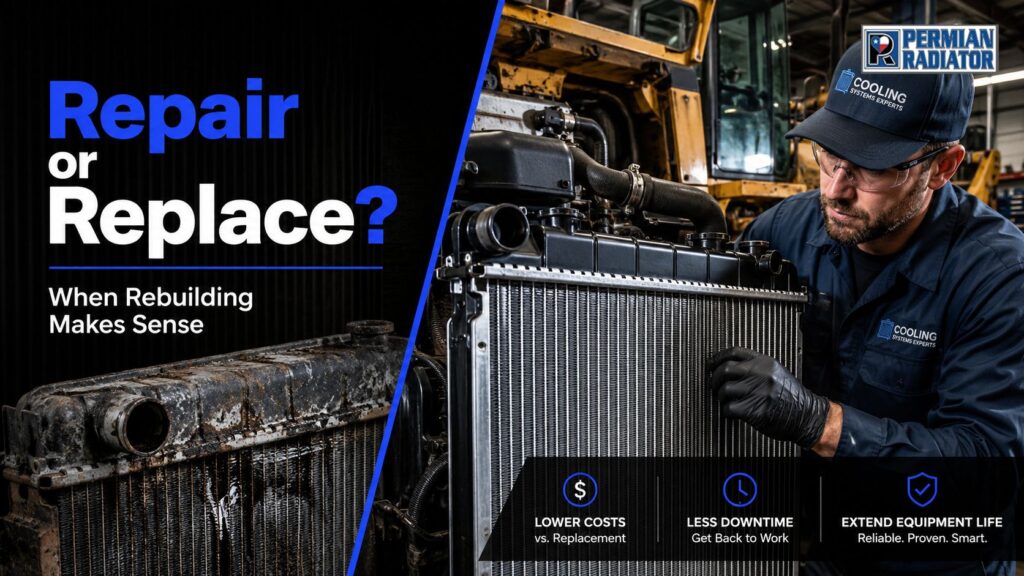
When comparing industrial radiator repair vs replacement, rebuilding is usually worth considering when the radiator’s reusable structure, tanks, mounting points, or other major components are still serviceable but the core or other replaceable sections have deteriorated. Full replacement generally makes more sense when damage is widespread, structural sections are badly compromised, corrosion affects multiple areas, the unit has a history of repeated failures, or the radiator no longer meets the cooling demands of the equipment.
The decision should not start with, “Which option costs less?” It should start with, “What actually failed, why did it fail, and what parts of this radiator are still worth keeping?”
For fleet operators, oilfield crews, construction companies, and industrial facilities around San Angelo, that distinction matters. Replacing a repairable radiator can mean unnecessary expense and sourcing delays, while repeatedly patching a worn-out unit can create another shutdown when the equipment is needed most.
Industrial radiator repair vs replacement: understand the four options first
Before deciding what to do with a damaged radiator, separate four terms that often get used interchangeably.
Radiator repair addresses a specific problem. Depending on radiator construction and condition, that might include correcting a leak, repairing a connection, cleaning restricted passages, replacing damaged components, or addressing localized damage.
A radiator rebuild is broader. The radiator is evaluated as an assembly, serviceable components are retained, worn or failed components are repaired or replaced, the unit is cleaned, reassembled, and tested.
A radiator recore replaces the heat-transfer core while retaining usable tanks, frames, mounting hardware, or other portions of the existing assembly. Industrial radiator specialists commonly use recoring when core deterioration is the main problem but the surrounding hardware remains serviceable.
Industrial radiator replacement means installing a different complete radiator assembly rather than restoring the existing unit.
Option | Usually suited for | Main limitation |
Repair | Localized, repairable damage | May not solve widespread deterioration |
Rebuild | Several serviceable components can be reused | Depends heavily on overall condition |
Recore | Core is failing, but tanks/frame remain usable | Other retained components must still be sound |
Replacement | Severe damage, poor remaining condition, or unsuitable existing design | Availability, fitment, and procurement can affect downtime |
In short: Do not treat every leaking radiator as a replacement job or every repairable radiator as a rebuild candidate. The correct option depends on what remains structurally and functionally usable.
When should an industrial radiator be rebuilt?
Usually when deterioration is significant enough that a small repair would be temporary, but enough of the original assembly remains sound to justify restoration.
That situation is common on heavy-duty radiators where the core has suffered years of heat cycling, vibration, debris exposure, corrosion, or restricted airflow while tanks, frames, brackets, and mounting dimensions remain usable.
Signs that a radiator rebuild or radiator recore deserves serious consideration include:
- The core is clogged, deteriorated, leaking, or physically damaged.
- Tanks and mounting structures remain in serviceable condition.
- The radiator fits specialized or older equipment that would be difficult to match quickly.
- Previous minor repairs are becoming more frequent.
- Cooling performance has declined even after routine cleaning.
- The unit can be restored without relying on questionable temporary patches.
- Replacement availability could keep the equipment out of service longer than rebuilding it.
A rebuild is not simply “fixing the leak again.” Done correctly, it addresses the damaged portions of the assembly while preserving components that still have useful service life.
In short: Rebuilding makes the most sense when the radiator has substantial repairable value left, but a basic patch no longer addresses its condition.
What radiator condition tells you about rebuilding versus replacement?
A visual inspection alone is not enough for a serious industrial cooling system decision.
A radiator may look dirty but be structurally sound. Another may look acceptable from the outside while corrosion, blocked tubes, weak joints, or internal contamination have already reduced its ability to operate reliably.
A shop evaluating industrial radiator repair should look at several areas.
Core condition
The core contains the tubes and fins responsible for transferring heat. Because these components use relatively thin material and are exposed to airflow, debris, chemicals, vibration, and thermal cycling, they commonly become the damaged portion of industrial radiators.
Localized fin damage or contamination may call for cleaning or repair.
Widespread tube deterioration, severe blockage, or numerous core leaks may point toward a radiator recore rather than another localized repair.
Tanks, headers, and frame
A bad core does not automatically make the rest of the radiator unusable.
If tanks, mounting structures, brackets, headers, and other reusable sections remain in good condition, retaining them can make rebuilding practical.
When those sections are cracked, heavily corroded, distorted, weakened, or damaged across several areas, industrial radiator replacement becomes easier to justify.
Radiator construction
Material matters because copper-brass, aluminum, steel, and mixed-material radiators are constructed differently and do not respond to every repair technique in the same way.
For that reason, repairability should be determined from the actual radiator design rather than from a blanket rule that every radiator can be repaired the same way.
Failure history
One repair is different from the fourth repair to the same aging unit.
Repeated leaks, recurring overheating, or continuing cooling problems can indicate that the visible failure is only one symptom of broader deterioration.
At that point, continuing with isolated repairs may be poor maintenance planning even if each leak appears fixable.
In short: Judge the complete assembly, not just the newest leak.
When is radiator replacement the better choice?
There are times when rebuilding would simply postpone the inevitable.
Replacement deserves stronger consideration when damage extends beyond a replaceable core or repairable component and begins affecting the integrity, reliability, or suitability of the full assembly.
That can include:
- Severe or widespread radiator corrosion
- Damage across tanks, frames, headers, and mounting areas
- Significant crushing or distortion
- Multiple weak or leaking areas
- Repeated failures after previous repairs
- Contamination that cannot be adequately removed
- A radiator that is undersized for the machine’s current operating demand
- A changed equipment configuration requiring different cooling capacity
- A readily available replacement that offers a better lifecycle decision than rebuilding the old unit
Coolant contamination deserves particular attention. Caterpillar notes that contaminated coolant can contribute to corrosion and radiator failure and recommends proper coolant, scheduled flushing, radiator inspection, and regular fin cleaning as preventive measures.
Simply installing another radiator without correcting the contamination or operating problem can put the replacement at risk as well.
In short: Replace the radiator when too little reliable structure remains to rebuild or when the existing unit itself is no longer right for the application.
Repair, rebuild, or replace? Use this decision checklist
Fleet and maintenance managers do not need to diagnose every tube themselves. They do need to know what questions to ask before authorizing a major repair.
Use this checklist when evaluating industrial radiator repair vs replacement:
- Where is the failure?
Is the problem confined to the core, a tank, a connection, or another specific component? - How widespread is the deterioration?
One repairable area is different from corrosion or leakage in several sections. - Are the tanks and frame worth retaining?
A recore becomes far less attractive if the surrounding structure is already near the end of its useful life. - Has the radiator been repaired repeatedly?
Look at maintenance history rather than judging the current failure in isolation. - Why did it fail?
Contamination, poor coolant maintenance, blocked airflow, vibration, impact, and overheating can all contribute to radiator problems. Caterpillar specifically identifies impact and coolant contamination as possible causes of radiator failure. - Does the radiator still have enough cooling capacity for the application?
Rebuilding the wrong radiator does not solve a capacity problem. - Is a replacement actually available?
For specialized industrial equipment, procurement and fitment deserve consideration alongside the repair invoice. - What testing will be performed before the unit returns to service?
Ask how the shop verifies leaks, pressure integrity, cleanliness, and overall condition.
Expert tip: Compare the complete operational decision, not only the radiator invoice. A lower-priced option becomes expensive quickly if it causes another unscheduled equipment shutdown.
Why downtime changes the rebuild-or-replace calculation
For a passenger vehicle, radiator failure is inconvenient. For a frac unit, loader, generator, commercial truck, agricultural machine, or industrial system, the bigger problem may be fleet downtime.
That changes how maintenance teams should compare options.
Imagine a specialized radiator with a damaged core but reusable tanks and mounting hardware. If an equivalent complete replacement is readily available, replacement may be perfectly reasonable.
If that replacement has to be sourced, shipped, modified, or custom ordered, a technically sound recore may return the existing assembly to service without waiting for an entirely new unit.
The reverse can also happen. If a radiator has been repaired repeatedly and an appropriate replacement is sitting on the shelf, rebuilding the old unit simply because it is technically possible may not be the smart operational decision.
Equipment-management guidance outside the radiator industry follows the same logic: repair and rebuilding can reduce replacement expense, but aging condition, part support, downtime, remaining service life, and future maintenance requirements all need to be considered together.
In short: The right choice minimizes total operational risk, not just today’s parts bill.
What happens during a professional radiator rebuild?
The exact process varies with radiator design and condition, but a serious radiator rebuild normally involves much more than sealing the visible leak.
The job may include:
- Inspecting the complete radiator assembly
- Performing radiator pressure testing to locate leaks or weak areas
- Disassembling serviceable components where appropriate
- Cleaning internal and external surfaces
- Evaluating tanks, headers, brackets, joints, cores, and mounting structures
- Repairing or replacing damaged components
- Installing a new core when recoring is required
- Reassembling the radiator
- Testing the completed unit before it returns to service
Professional industrial radiator facilities also use cleaning, component replacement, rebuilding, recoring, and testing as different tools rather than treating every radiator failure the same way.
For an equipment manager, the important question is not whether the shop calls the job a “rebuild.” Ask what is actually being reused, what is being replaced, and how the completed radiator will be tested.
In short: A rebuild should correct the condition of the assembly, not disguise one visible symptom.
Do not rebuild the radiator without finding the cause of failure
This is where maintenance decisions frequently go wrong.
A failed radiator may be the damaged component, but it may not be the root problem.
Before returning a rebuilt or replacement radiator to hard service, check for conditions that could damage it again:
- Incorrect or contaminated coolant
- Scale or internal deposits
- Restricted airflow
- Dirty or blocked fins
- Damaged hoses
- Cooling fan problems
- Excessive vibration
- Improper mounting
- System overpressure
- Oil or other fluid contamination
- Previous overheating events
Routine cooling system inspection matters here. Caterpillar recommends radiator inspection, checking hoses and caps, keeping fins clear, using the correct coolant, and flushing according to the equipment’s maintenance schedule.
Heavy-duty engine guidance also emphasizes cooling-system maintenance because corrosion, scale, contamination, and coolant condition can affect system reliability.
For oilfield and industrial equipment working around West Texas dust, heat, vibration, and heavy loads, checking the entire cooling package is far more useful than repeatedly treating the radiator as an isolated part.
In short: A new or rebuilt radiator can fail again if the condition that damaged the original unit is still present.
Industrial radiator repair in San Angelo: what should you ask the shop?
When looking for industrial radiator repair in San Angelo, TX, ask for a diagnosis before asking for a rebuild or replacement quote.
A useful conversation should cover:
- What component actually failed?
- Is the core repairable, or does it need recoring?
- Are the tanks and frame structurally sound?
- Is there evidence of internal radiator corrosion?
- Can contamination be fully cleaned out?
- Has repeated repair made replacement more sensible?
- Does the existing radiator still suit the equipment?
- Will the radiator be pressure-tested before return to service?
- Are other coolers in the cooling package showing similar contamination or damage?
Permian Radiator works with commercial, industrial, and heavy-duty radiator repair applications as well as hydraulic oil coolers, lube oil coolers, transmission fluid coolers, cooling-system cleaning, flushing, inspection, and pressure testing.
For operators in San Angelo and across the Permian Basin, that broader cooling-system view is useful because overheating or contamination may involve more than one heat-transfer component.
In short: Ask the shop to explain why it recommends repair, rebuilding, recoring, or replacement. A good diagnosis should make that recommendation understandable.
Decide the radiator’s condition, not an assumption
The smartest approach to industrial radiator repair vs replacement is not automatically choosing whichever option sounds cheaper.
If the core is failing while tanks, mounting hardware, and other major components remain sound, a professional radiator rebuild or radiator recore may preserve a useful industrial assembly and avoid an unnecessary complete replacement.
If corrosion is widespread, structural sections are compromised, failures keep returning, or the radiator no longer suits the machine’s cooling requirements, replacement may be the more responsible choice.
Permian Radiator serves San Angelo, TX and the Permian Basin with commercial, industrial, and heavy-duty radiator repair, rebuilding, replacement, pressure testing, cleaning, flushing, and cooler repair services.
If your equipment is overheating, leaking coolant, losing cooling capacity, or repeatedly coming back for radiator repairs, call Permian Radiator, request a free quote, or schedule service to have the unit inspected before deciding whether to repair, rebuild, recore, or replace it.
Frequently Asked Questions
Repair is usually worth considering when damage is localized, and the rest of the assembly remains healthy. Replacement becomes more appropriate when structural deterioration, widespread corrosion, repeated failures, or unsuitable cooling capacity make further investment in the existing unit difficult to justify.
It can be when valuable portions of the original assembly remain serviceable, and rebuilding provides a dependable way to restore the damaged sections. It is not automatically worthwhile when tanks, frames, headers, and other major components are deteriorating too.
Many industrial radiator designs can be recored when the core has failed, but reusable tanks, frames, and related components remain in suitable condition. A radiator shop should inspect the complete unit before recommending recoring.
Recoring specifically replaces the radiator's heat-transfer core while retaining usable surrounding components. Rebuilding is a broader restoration process that may include recoring along with cleaning, component repair or replacement, reassembly, and testing.
No. Overheating can come from restricted airflow, low coolant, contamination, fan problems, damaged hoses, circulation problems, radiator restriction, or other cooling-system faults. Diagnose the system before replacing the radiator.
Common causes include corrosion, coolant contamination, blocked fins, internal deposits, vibration, impact damage, leaks, and repeated overheating. The operating environment and maintenance history should be considered when diagnosing the failure.
Follow the equipment manufacturer's coolant and service requirements, keep radiator fins clean, inspect hoses and connections, watch for leaks and contamination, and investigate temperature changes before the equipment experiences a major overheat. Regular radiator maintenance is far easier to plan around than an emergency shutdown.


 ICONIER Digital Marketing Agency