
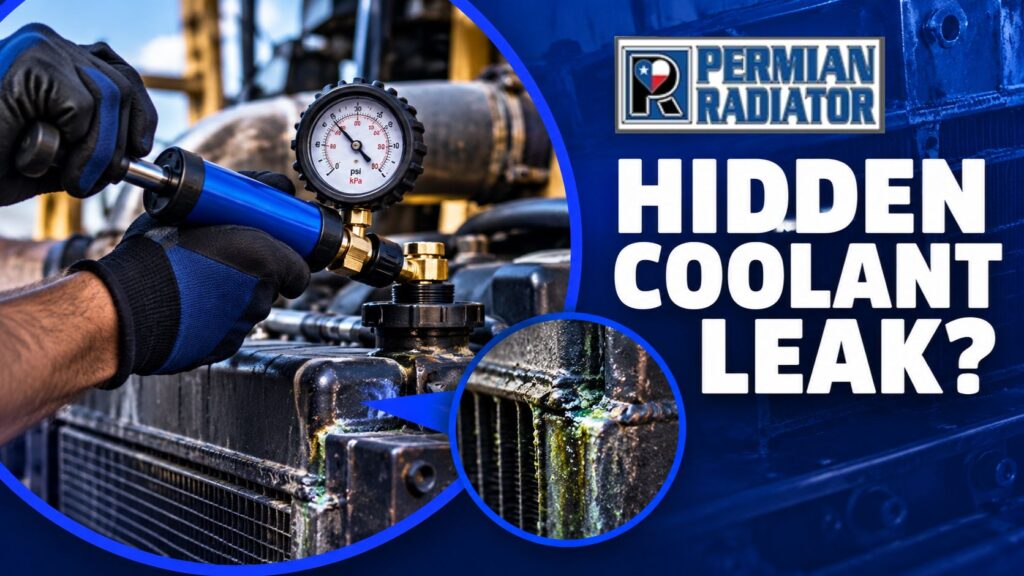
Yes. A radiator pressure test can reveal small cooling-system leaks that may not be obvious during a visual inspection by pressurizing a cool system to the manufacturer-specified test pressure and checking whether it holds. However, a pressure drop confirms that the system is losing pressure; it does not automatically prove the radiator is the leaking component or identify every type of internal engine fault.
That distinction prevents a useful diagnostic test from turning into an incorrect parts diagnosis.
How Does a Radiator Pressure Test Work?
During a cooling system pressure test, a technician connects the appropriate test equipment to the radiator or expansion-tank connection on a cooled, depressurized system.
The system is then brought to the specified test pressure.
The gauge is monitored.
If pressure falls beyond the permitted amount, the technician checks for leakage.
Possible locations include:
- Radiator core
- Radiator seams
- Hoses
- Clamps
- Expansion tank
- Fittings
- Heater circuit
- Water-pump area
- Gaskets or seals
- Other cooling-system connections
The exact procedure and acceptable pressure loss vary by equipment.
In short: The test creates controlled pressure so small leaks become easier to detect.
Why Some Coolant Leaks Are Hard to Find
A hidden coolant leak may not leave a puddle every time equipment is parked.
A small defect can behave differently depending on:
- System temperature
- Pressure
- Engine vibration
- Equipment load
- Component movement
- Leak location
Coolant may also evaporate from a hot surface before forming an obvious puddle.
Sometimes the only clues are:
- Repeated coolant top-offs
- Dried residue
- Coolant odor
- Occasional temperature rise
- Dampness around a connection
- Pressure loss
That is where pressure testing becomes useful.
What Can a Pressure Test Find?
A controlled cooling system leak test can help identify external leakage from several areas.
Radiator core leaks
Small tube or seam leaks can become visible when the system is under pressure.
Hose and clamp leaks
A connection that appears dry at rest may seep during testing.
Expansion tank leaks
Cracks and sealing issues may release pressure.
Water-pump or seal leakage
Depending on system design and failure mode, testing can reveal leakage around pump areas or seals.
Fitting and connection leaks
Threaded fittings, sensor ports, hose necks, and other joints can leak.
Radiator cap problems
A separate radiator cap test may be used to verify whether the cap maintains and releases pressure according to its specification.
In short: Pressure testing evaluates the system, not only the radiator.
What Does It Mean if Cooling System Pressure Drops?
For what does it mean if cooling system pressure drops, the system is not maintaining the test pressure as expected.
Before blaming the radiator, verify:
- Tester connection
- Correct adapter
- Test procedure
- Hose connections
- Tank seams
- Core
- Pump area
- Other visible components
If external leakage cannot be located, further diagnosis may be needed.
A pressure loss is evidence.
It is not the complete diagnosis.
Can a Pressure Test Find an Internal Coolant Leak?
Sometimes it can provide evidence that an internal problem may exist.
For ” Can a pressure test find an internal coolant leak, a system that loses pressure without any visible external leak may justify additional investigation.
Possible internal concerns can involve:
- Head gasket
- Cylinder head
- Engine block
- Internal heat exchanger
- Other fluid-to-fluid cooler depending on equipment design
Additional testing may be needed to identify the actual cause.
That can include manufacturer-approved combustion-gas testing, fluid inspection, cooler testing, cylinder testing, or other diagnostic procedures.
Do not condemn an engine based on a pressure gauge alone.
Why Test Pressure Must Match the Equipment
More pressure does not make a leak test more accurate.
It can make the test unsafe.
The pressure testing heavy equipment procedure should use the pressure specified by the manufacturer for that cooling system.
Excessive pressure can:
- Damage the radiator
- Damage seals
- Stress hoses
- Create new leaks
- Distort components
The system should also be cool and depressurized before the cap is removed or testing equipment is connected.
Expert takeaway: A pressure tester is a measuring tool, not a way to “stress test” the cooling system beyond its design.
Can Pressure Testing Catch a Leak Before an Overheating Failure?
It can.
A small leak can slowly reduce coolant level or prevent the cooling system from maintaining normal pressure.
If detected during maintenance, that leak may be repairable before it contributes to a larger cooling problem.
This is one reason heavy-duty radiator inspection should pay attention to coolant history.
If an operator repeatedly adds coolant, that pattern deserves investigation even if the equipment is not overheating yet.
When Should You Consider a Pressure Test?
Testing may be useful when:
- Coolant level repeatedly drops
- A leak is suspected but cannot be located
- Dried coolant residue is visible
- The radiator has been repaired
- Hoses or cooling components were replaced
- Equipment has an unexplained overheating complaint
- A repaired radiator needs verification
- A cap is suspected of leaking
Pressure testing should not automatically be performed just because equipment enters the shop.
It should answer a diagnostic or verification question.
Should a Radiator Be Pressure Tested After Repair?
In many radiator-repair situations, yes.
For should a radiator be pressure tested after repair, the purpose is to verify that the repaired component maintains the appropriate test pressure before it returns to service.
Testing does not replace inspection.
The technician should still verify:
- Repair quality
- Core condition
- Tank condition
- Connections
- Mounts
- Fins
- Cleanliness
A radiator can hold pressure while still having poor airflow or heat-transfer performance.
Pressure Test vs. Visual Inspection
Method | What it is good at | What it can miss |
Visual inspection | Obvious leaks, stains, damaged hoses, physical damage | Small pressure-dependent leaks |
Pressure test | System integrity and pressure-dependent leakage | Some internal faults and heat-transfer problems |
Cap test | Cap sealing/opening performance | Other system faults |
Temperature testing | Heat-transfer and operating patterns | Small leaks with no temperature effect yet |
Fluid inspection | Contamination and coolant condition | Exact location of an external leak |
Good cooling-system diagnosis may use several of these together.
Pressure Testing Does Not Measure Radiator Cooling Capacity
This point is easy to miss.
A radiator can pass a radiator pressure test and still have:
- Externally blocked fins
- Internal restrictions
- Poor airflow
- Damaged fins
- Inadequate heat rejection
- Contamination
Pressure testing asks, “Does this system hold pressure?”
It does not fully answer, “Can this radiator remove enough heat under load?”
If equipment overheats but does not lose coolant, airflow, fluid flow, fan performance, thermostat operation, water-pump performance, and cooling capacity still need attention.
What Should You Do if the Test Finds a Leak?
The next step depends on where the leak is found.
A radiator shop may recommend:
- Localized repair
- Hose or connection repair
- Cap replacement
- Cleaning
- Radiator rebuild
- Recoring
- Complete replacement
- Further engine diagnosis
A small repairable radiator leak does not always require a complete replacement.
Likewise, repeated leaks across a deteriorated core may make isolated repair less practical.
Frequently Asked Questions
Yes.
For can a pressure test find a small coolant leak, controlled system pressure can make a pressure-dependent leak easier to see than it is during a cold visual inspection.
For how does a radiator pressure test work, the cooled cooling system is pressurized to its specified test pressure and monitored to see whether it maintains pressure.
A drop means pressure is escaping somewhere or the test setup itself is not sealed correctly.
The source must still be located.
It may provide evidence of an internal problem when pressure drops without an external leak, but additional diagnosis is generally needed to identify the actual failure.
Pressure testing is commonly useful for verifying leak repairs when performed to the correct specification.
Yes.
A radiator may hold pressure but have restricted airflow, internal blockage, damaged fins, or insufficient heat-transfer performance.
It is when the correct equipment, safe procedure, cooled system, and manufacturer-specified pressure are used.
Find Small Leaks Before They Become Bigger Cooling Problems
A radiator pressure test is a practical way to find pressure-dependent leaks and verify cooling-system integrity before a small coolant loss turns into a larger problem.
It is also only one part of diagnosis.
The test needs to be performed at the correct pressure, and a failed result needs to be traced to the actual leaking component before repairs are approved.
Permian Radiator provides cooling-system inspection, pressure testing, radiator repair, rebuilding, maintenance, and replacement for commercial, industrial, heavy-duty, and automotive applications serving San Angelo and the Permian Basin.
If you are adding coolant, seeing residue, or dealing with a leak that is difficult to locate, call Permian Radiator to schedule service or request a quote.


 ICONIER Digital Marketing Agency