
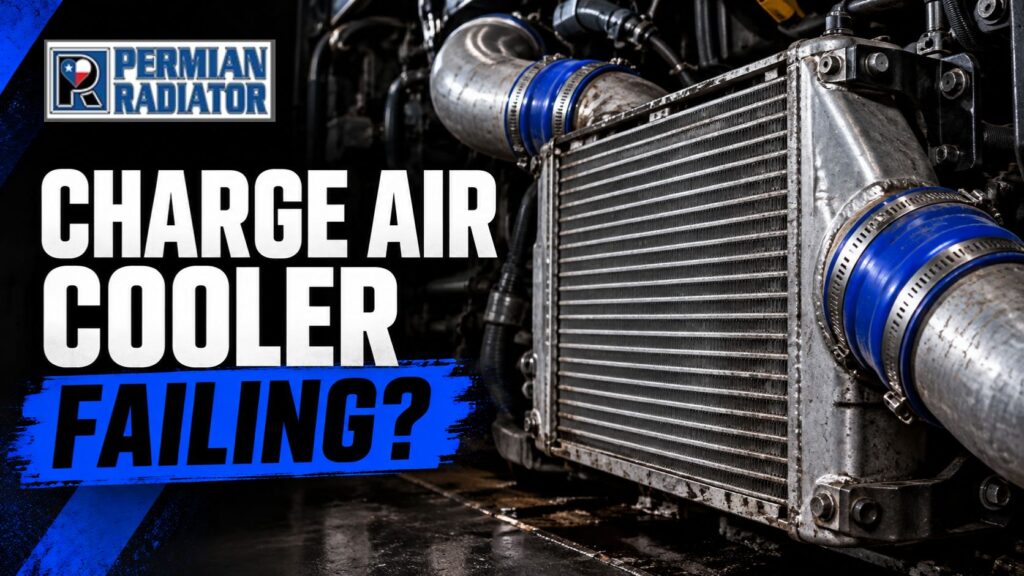
Common signs of a failing charge air cooler include loss of power under load, lower-than-normal boost, hissing during acceleration, increased fuel use, black exhaust smoke, high intake or exhaust temperatures, and visible damage or oil staining around the charge-air system. None of these symptoms proves that the cooler itself has failed, so the CAC, hoses, boots, clamps, piping, and connections should be inspected and pressure-tested before parts are replaced.
That last step matters on heavy-duty equipment because a leaking connection can feel a lot like a damaged cooler.
What Does a Charge Air Cooler Actually Do?
A turbocharger compresses intake air.
Compression heats that air.
The charge air cooler removes part of that heat before the air enters the engine.
Cooler, denser intake air helps the engine receive the mass of air expected by its fueling and boost strategy.
If the cooler leaks or cannot transfer heat effectively, engine performance can change noticeably.
In short: The CAC does not cool engine coolant. It cools compressed intake air between the turbocharger and engine.
1. The Equipment Loses Power Under Load
One of the more noticeable charge air cooler symptoms is reduced pulling power.
The machine may:
- Feel normal at light load
- Accelerate poorly
- Struggle as engine demand increases
- Lose performance on grades
- Need more throttle than usual
- Feel as though the turbocharger is not producing normal boost
This happens because a CAC leak allows compressed air to escape before it reaches the engine.
The symptom may not be obvious at idle because boost pressure is much lower.
In short: Power loss that appears primarily as boost rises is a reason to inspect the complete charge-air system.
2. Boost Pressure Is Lower Than Normal
A low boost under load complaint can point toward a charge-air leak.
It can also come from many other problems.
Possible causes include:
- Split CAC boots
- Loose clamps
- Cracked charge-air piping
- Leaking CAC seams
- Damaged CAC core
- Turbocharger problems
- Exhaust-side leaks
- Sensor or control problems
That is why replacing a charge air cooler based on a low-boost code alone is risky.
The system needs diagnosis.
3. You Hear a Hissing or Rushing-Air Sound
Compressed air escaping through a split hose, loose connection, crack, or failed seam can produce a hissing sound.
It may be easiest to hear when:
- Accelerating
- Pulling a load
- Building boost
- Operating at higher engine demand
The sound does not tell you where the leak is.
Inspect the complete path from the turbocharger through the CAC to the intake.
4. Fuel Consumption Changes
A boost leak can disrupt the amount of air reaching the engine.
Depending on the engine and control system, the operator may notice poorer efficiency along with reduced performance.
However, fuel consumption can change for dozens of reasons.
Use it as supporting evidence, not as proof of CAC failure.
A useful diagnostic question is whether the fuel-use change appeared at the same time as low boost, poor pulling power, smoke, or another charge-air symptom.
5. Black Smoke Appears Under Load
Black smoke under load can occur when combustion does not have the expected amount of air.
A leaking charge-air system is one possible cause.
Other causes can involve:
- Fuel delivery
- Air filters
- Turbocharger operation
- Sensors
- Injectors
- Engine mechanical condition
The smoke color, operating condition, fault codes, boost readings, and service history should be considered together.
In short: Black smoke plus low boost deserves charge-air inspection, but black smoke alone does not diagnose the CAC.
6. Intake or Exhaust Temperatures Are Abnormal
A CAC must perform two jobs:
- Hold boost pressure.
- Remove heat from compressed air.
A cooler can therefore have a performance problem even when the core is not visibly cracked.
External contamination can reduce airflow through the fins.
Bent fins can reduce open airflow area.
Internal contamination or physical damage may also reduce heat-transfer performance.
A technician can compare operating temperatures and other readings with the equipment manufacturer’s specifications to determine whether the system is doing its job.
7. You See Oil Residue Around Charge-Air Connections
A light oil film can sometimes appear in turbocharged intake plumbing.
Heavy wet residue around one connection, however, deserves inspection.
Escaping pressurized air can carry oil mist through a leaking boot or connection, leaving a visible stain.
Check:
- Clamps
- Boots
- Pipe joints
- CAC inlet
- CAC outlet
- Core seams
Do not assume oil residue means the CAC core itself is leaking.
It may simply help you find the area that needs testing.
8. The Core Has Visible Physical Damage
Heavy-duty equipment works in environments where vibration and debris can damage cooling components.
Inspect the CAC for:
- Bent fins
- Cracks
- Damaged tubes
- Impact marks
- Loose mounting points
- Worn areas
- Corrosion
- Damaged connections
Physical damage becomes more meaningful when it matches performance symptoms or a failed pressure test.
How Do You Test a Charge Air Cooler for Leaks?
For how to test a charge air cooler for leaks, the correct procedure depends on the equipment manufacturer.
A controlled charge air cooler pressure test can determine whether the charge-air system maintains pressure within specification.
Technicians should also inspect:
- Boots
- Clamps
- Tubes
- Pipes
- Connections
- CAC seams
- Core
Do not guess at test pressure.
Follow the engine or equipment manufacturer’s procedure and test limits.
A system that fails the test still needs the leak located. The failure may be in a hose or connection rather than the cooler.
In short: Pressure testing confirms whether the system leaks; inspection determines which component is responsible.
CAC Problem vs. Similar Symptoms
Symptom | CAC/boost leak possible? | Other areas to inspect |
Power loss under load | Yes | Turbo, fuel, exhaust, engine |
Low boost | Yes | Turbo, sensor, piping, controls |
Hissing under boost | Yes | Boots, clamps, hoses, pipes |
Black smoke | Yes | Fuel, air filter, injectors, turbo |
Increased fuel use | Yes | Engine, tires/load, fuel system |
High temperatures | Yes | Airflow, engine load, cooling system |
Oil residue at connection | Yes | Boot, clamp, pipe, turbo system |
The value of the table does not decide which part to replace.
It is showing why diagnosis matters.
Can a Bad Charge Air Cooler Affect the Radiator?
Indirectly, it can affect the cooling package.
Many heavy-duty machines place the CAC in front of or near the radiator.
If the CAC fins are packed with debris, airflow to the radiator behind it can also be reduced.
That means an externally blocked charge air cooler may contribute to:
- Higher intake-air temperatures
- Reduced radiator airflow
- Higher engine coolant temperatures
When one cooling-stack component is dirty, inspect the others too.
Repair or Replace the Charge Air Cooler?
The answer depends on:
- Material
- Leak location
- Damage extent
- Core condition
- Equipment application
- Manufacturer requirements
- Replacement availability
- Previous repairs
Some damage may be repairable.
Other failures require replacement.
Do not use stop-leak products or improvised sealing methods in a charge-air system unless specifically approved for that application.
Frequently Asked Questions
For what happens when a charge air cooler fails, boost may escape or compressed air may not be cooled effectively.
The result can include reduced power, abnormal temperatures, low boost, smoke, or poor efficiency.
Yes. Can a bad charge air cooler cause power loss is especially relevant when the loss becomes more obvious as boost and engine load increase.
Yes.
A CAC leak allows pressurized intake air to escape before reaching the engine.
It can contribute when inadequate intake air affects combustion, but can a bad charge air cooler cause black smoke should not be treated as a one-symptom diagnosis.
Inspect and pressure-test the complete charge-air circuit.
Bubbles, audible leakage, pressure loss, or another approved diagnostic method can help isolate the actual leak location.
Yes, particularly when it sits ahead of the radiator.
A blocked CAC can affect both charge-air temperature and airflow through the rest of the cooling pack.
Diagnose the System Before Replacing the Cooler
The signs of a failing charge air cooler overlap with turbo, hose, fuel, sensor, and engine problems.
Loss of power under load, low boost, hissing, smoke, temperature changes, and visible damage are reasons to investigate, not reasons to order a part blindly.
Permian Radiator works with heavy-duty and industrial cooling equipment serving San Angelo and the Permian Basin.
If your equipment is losing performance, developing cooling problems, or needs its cooling package inspected, contact Permian Radiator to schedule service or request a quote.


 ICONIER Digital Marketing Agency