
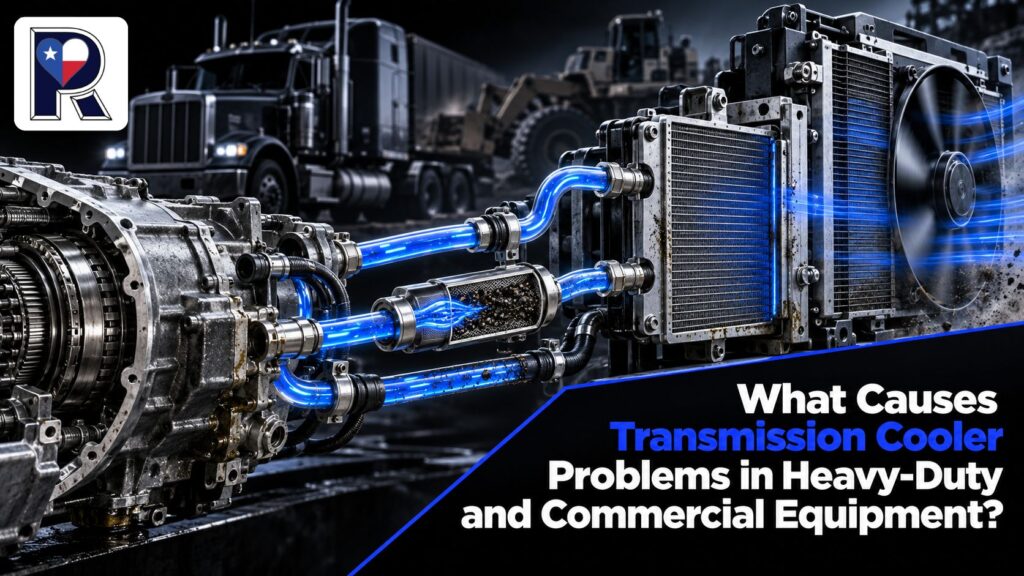
Transmission cooler problems are commonly caused by blocked airflow, internal contamination, restricted or leaking cooler lines, corrosion, vibration damage, low fluid, heavy operating loads, an undersized cooler, or excessive heat generated inside the transmission. The cooler may be involved, but it is not always the source of the overheating.
A responsible diagnosis checks the complete cooling circuit before replacing parts. That includes the cooler, fan, fluid lines, transmission fluid, temperature sensor, radiator or heat exchanger, operating load, and internal transmission condition.
How a Heavy-Duty Transmission Cooler Works
A transmission cooler is a heat exchanger. Hot transmission fluid passes through the cooler, transferring heat to the outside air, engine coolant, or another cooling medium before returning to the transmission.
Heavy-duty equipment may use several cooler arrangements:
- An air-to-oil cooler mounted in the cooling stack
- An oil-to-coolant heat exchanger
- A transmission cooler integrated into a radiator
- A separate auxiliary cooler
- A combination of primary and auxiliary cooling
The cooler must receive sufficient transmission fluid and cooling air or coolant to operate properly. A restriction on either side reduces heat transfer.
The cooler must also match the transmission’s flow, pressure, heat-rejection requirements, and duty cycle. A physically similar unit is not automatically a suitable replacement.
In short: The cooler controls transmission-fluid temperature by transferring heat. Problems occur when fluid flow, airflow, coolant flow, heat transfer, or cooler capacity falls below what the equipment requires.
What Causes Transmission Cooler Problems?
1. Dirt and debris block the cooling surface
Air-cooled transmission coolers depend on clean fins and unrestricted airflow. Dust, mud, insects, vegetation, oil residue, and other debris can cover the core and trap heat.
This issue is easy to miss when multiple heat exchangers are stacked together. The visible front surface may look clean while debris remains packed between the air-conditioning condenser, charge-air cooler, radiator, hydraulic cooler, and transmission cooler.
A dirty core can also indicate a leak. Oil escaping from a fitting or damaged tube attracts dust and creates a heavier layer of buildup.
2. The fan is not moving enough air
A clean cooler cannot release enough heat if the fan is damaged, turning in the wrong direction, running too slowly, or failing to start.
Possible fan-related causes include:
- A worn or slipping belt
- A failed electric motor
- Low speed from a hydraulic fan drive
- Damaged blades
- A missing or damaged shroud
- A bad relay, sensor, wiring connection, or temperature switch
- Hot discharge air recirculating through the cooling stack
The fan may appear to be running but still fail to produce the required airflow. Direction, speed, blade condition, and shroud clearance should all be checked.
3. The cooler is internally restricted
A clogged transmission cooler may contain clutch material, metal particles, degraded fluid deposits, seal fragments, corrosion products, or contamination left from an earlier transmission failure.
Internal restrictions reduce fluid flow and may increase pressure drop. They can also create hot spots inside the cooler.
A cooler that was connected to a failed transmission should not automatically be reused. Some cooler designs can be cleaned and tested, while others may retain contamination in passages that cannot be inspected properly.
4. Cooler lines are damaged or restricted
Bent tubes, kinked hoses, crushed fittings, incorrect routing, deteriorated hose material, and undersized replacement lines can restrict circulation.
Soft hose material can sometimes collapse under operating conditions even when it looks normal during a visual inspection. A line routed too close to an exhaust component may also expose the fluid to additional heat.
Restricted cooler lines can make a good cooler appear defective because the required amount of fluid never reaches it.
5. The system is losing transmission fluid
A transmission cooler leak may develop at the core, fittings, seals, hoses, hard lines, or connections inside an integrated radiator-style cooler.
Low fluid reduces the transmission’s ability to lubricate components, apply clutches, transfer power, and carry heat away. The transmission may begin slipping, which creates more heat and accelerates the problem.
Do not assume a low fluid level means the cooler itself is leaking. The entire transmission and cooling circuit should be inspected.
6. Oil and coolant are mixing
An internal breach in an oil-to-coolant cooler can allow transmission fluid and coolant to mix. The direction of contamination depends on system pressure and operating conditions.
Possible warning signs include:
- An oily film in the coolant
- Unexplained coolant loss
- Rising transmission-fluid level
- Milky, cloudy, or unusual-looking fluid
- Contaminated hoses or reservoir surfaces
- Repeated overheating after a fluid change
Fluid mixing requires prompt attention. Replacing contaminated fluid without repairing the breach will not solve the problem.
7. Corrosion, scaling, or erosion damages the core
Water-cooled heat exchangers may develop scale, sediment, or corrosion on the coolant side. Oil passages may collect deposits from degraded or contaminated transmission fluid.
Over time, corrosion can thin tubes or plates until they begin leaking. High fluid velocity, unsuitable chemistry, vibration, or abrasive particles may also damage internal surfaces.
Cleaning can restore a fouled but structurally sound cooler. It cannot replace metal lost to corrosion or erosion.
8. Vibration and thermal cycling weaken the cooler
Heavy-duty and industrial equipment subjects coolers to vibration, pressure changes, and repeated heating and cooling.
These forces can damage:
- Brazed seams
- Soldered joints
- Tube connections
- Mounting brackets
- Fittings
- Flexible lines
- Gaskets and seals
A cooler mounted under stress or without proper support may crack again after repair. The mount, brackets, line alignment, and vibration isolation should be checked along with the leak.
9. The fluid is incorrect or contaminated
Contaminated transmission fluid may contain wear material, dirt, coolant, water, or degraded-fluid deposits. These contaminants can restrict cooler passages and damage transmission components.
Using the wrong fluid may affect viscosity, friction characteristics, lubrication, clutch operation, and heat transfer. Fluid selection must follow the transmission manufacturer’s specification.
A fluid change may be necessary after overheating or contamination, but it should not be treated as a substitute for diagnosing the original problem.
10. The equipment is working beyond the cooler’s capacity
Towing, hauling, steep grades, slow-speed operation, repeated start-stop cycles, oilfield work, and continuous high-load operation all increase heat generation.
An original cooler may become inadequate after:
- An engine-power increase
- A transmission repower
- Increased vehicle weight
- Added towing or hauling demands
- Changes to gearing
- Reduced airflow caused by added equipment
- A change from intermittent to continuous operation
Caterpillar specifically warns that an existing cooler may be inadequate after certain transmission repowers and recommends matching the cooler to the required heat rejection.
11. The transmission is generating abnormal heat
The cooler may be functioning correctly while an internal transmission fault produces more heat than the cooling system can remove.
Possible sources include:
- Internal clutch slipping
- A failing oil pump
- Bearing or gear damage
- Incorrect clutch adjustment
- Excessive internal leakage
- Torque-converter problems
- Continued operation in an unsuitable gear
- Low or excessive fluid level
Eaton’s heavy-duty transmission guidance lists cooler flow, poor airflow, incorrect fluid level, internal pump failure, and internal transmission failure as possible overheating causes. It also recommends verifying the temperature gauge before concluding.
12. The temperature reading is inaccurate
A faulty sensor, damaged wiring connection, grounding problem, incorrect gauge, or software issue may report a temperature that does not match actual conditions.
The reading should be verified with approved diagnostic equipment before replacing a cooler or transmission. An inaccurate gauge does not make overheating impossible, but it should be ruled out early.
In short: Cooler trouble may begin with the core, fan, lines, fluid, operating load, cooling-system design, or transmission itself. Testing is more reliable than replacing the most visible component.
Common Warning Signs of Transmission Cooler Failure
Rising transmission temperature
A temperature that consistently rises under the same load and ambient conditions can indicate declining cooling performance or increased heat generation.
A single hot reading is not enough to identify the cause. Record the load, speed, ambient temperature, fluid level, fan operation, and time required for the temperature to rise.
Slipping, delayed engagement, or harsh shifts
Overheated, low, or degraded fluid can affect transmission operation. Slipping also generates additional heat, so it may be both a cause and a symptom.
These symptoms require a complete transmission diagnosis. Cooler repair alone may not correct internal clutch, pump, valve, or control problems.
Burnt odor or dark fluid
A burnt smell or unusually dark fluid may indicate that the transmission has been operating at an excessive temperature.
Fluid appearance cannot identify the exact failed component. Oil analysis and equipment-specific testing provide better evidence.
Visible leaks
Look for wet fittings, stained lines, oily cooler fins, fluid around mounting points, and drips beneath the equipment.
Clean the suspected area before confirming the source. Airflow can spread leaking fluid across the core and make the leak appear larger or farther away than it is.
Fluid contamination
Milky fluid, an oily coolant surface, unexpected fluid-level changes, or visible debris can point to internal leakage or component damage.
Contamination should be traced to its source before installing a repaired or replacement cooler.
Repeated high-temperature warnings under load
A cooler that handles light operation but loses control during heavy work may be blocked, undersized, receiving insufficient airflow, or dealing with abnormal internal transmission heat.
This pattern is common when the duty cycle has changed, or equipment operates in high ambient temperatures.
In short: Warning signs include rising temperature, shifting changes, leaks, burnt fluid, contamination, and overheating under load. None of these symptoms proves the cooler is the only failed component.
What the Symptoms May Tell You
What you observe | Possible cause | Useful next check |
Temperature rises only during heavy loads or long grades | High duty cycle, insufficient airflow, undersized cooler, or internal slipping | Compare load, fan speed, actual temperature, and cooler capacity |
Temperature remains high at light load | Restricted flow, incorrect fluid level, pump problem, internal transmission failure, or inaccurate sensor | Verify temperature, pressure, flow, and transmission condition |
Cooler surface is covered with oily dirt | External leak collecting debris | Clean the area and inspect the core, lines, and fittings |
One cooler line is hot while the other remains unusually cool | Restricted flow, blocked core, closed valve, or collapsed line | Perform flow and pressure-drop testing |
Pressure drop is higher than the manufacturer’s limit | Internal restriction, wrong fluid viscosity, damaged line, or undersized passages | Test at the specified fluid temperature and flow |
Fluid level keeps dropping | External leak or internal cooler breach | Pressure-test the cooler and inspect the entire circuit |
Oil appears in the coolant | Internal failure in an oil-to-coolant heat exchanger | Isolate and test the cooler before further operation |
A replacement cooler also overheats | Root cause was not corrected, cooler is mismatched, or airflow is inadequate | Recheck transmission heat generation and system design |
Temperature warning conflicts with other measurements | Sensor, wiring, gauge, or calibration problem | Verify the reading with approved diagnostic equipment |
Temperature difference between the cooler inlet and outlet can help evaluate performance, but it is not meaningful by itself. Fluid flow, equipment load, airflow, coolant temperature, and manufacturer specifications must also be considered.
How to Diagnose Transmission Cooler Problems Safely
Step 1: Record the operating conditions
Before shutting the equipment down, record information that can be collected safely:
- Transmission temperature
- Ambient temperature
- Equipment load
- Operating speed
- Gear or operating mode
- Fan operation
- Fluid-pressure readings
- Warning codes
- Time required for the temperature to rise
- Recent repair or fluid-change history
These details help reproduce the problem and separate load-related overheating from a constant fault.
Step 2: Follow the manufacturer’s shutdown procedure
Allow the equipment and fluid to cool before inspection. Use required lockout procedures and relieve pressure according to the service manual.
Never disconnect a hot, pressurized cooler line or use your hand to search for a pinhole leak. High-pressure fluid can penetrate skin and cause serious injury.
Step 3: Verify the temperature reading
Compare the equipment reading with an approved diagnostic method. Check the sensor, connector, wiring, gauge, fault codes, and calibration procedure.
Replacing cooling-system components based on an incorrect reading wastes time and may leave the actual electrical fault untouched.
Step 4: Check fluid level and condition
Use the manufacturer’s procedure because some transmissions must be checked at a specific temperature, engine speed, or operating condition.
Look for burnt odor, unusual color, visible debris, foam, coolant contamination, and an unexplained increase or decrease in fluid level.
Step 5: Inspect the external cooling system
Check:
- Cooler fins
- Cooling-stack cleanliness
- Fan blades and rotation
- Fan speed
- Shrouds and seals
- Guards and screens
- Hose and hard-line routing
- Mounting brackets
- Fittings and connections
- Evidence of leaks or vibration damage
Inspect between stacked coolers rather than checking only the front face.
Step 6: Test flow, pressure, and cooler integrity
A technician may conduct:
- Cooler-flow testing
- Inlet and outlet pressure measurements
- A transmission cooler pressure test
- Temperature measurements at both cooler connections
- Airflow or fan-speed testing
- A regulated leak test
- An internal cross-contamination test
Test pressure must follow the cooler manufacturer’s procedure. Applying uncontrolled shop-air pressure can damage the cooler or create a safety hazard.
Step 7: Evaluate the transmission
If cooler flow, airflow, and integrity are acceptable, inspect the transmission for excessive internal heat generation.
This may require pressure checks, electronic diagnostics, clutch evaluation, pump testing, oil analysis, or inspection for internal wear.
In short: Verify the temperature first, then check fluid, airflow, lines, cooler flow, pressure drop, and cooler integrity. Investigate the transmission itself if the cooling circuit passes testing.
Can a Clogged Transmission Cooler Cause Overheating?
Yes. A clogged transmission cooler can reduce fluid flow and heat transfer, allowing transmission-fluid temperature to rise.
An external blockage prevents air from moving through the fins. An internal blockage restricts transmission fluid or coolant inside the core.
Cleaning may solve external fouling or removable internal deposits. Replacement may be safer when contamination is trapped in inaccessible passages, especially after a serious transmission failure.
What Happens When a Transmission Cooler Leaks?
An external leak lowers the fluid level and may allow dirt to enter damaged connections. Low fluid can interfere with lubrication, clutch operation, pressure control, and heat removal.
An internal leak may allow transmission fluid and engine coolant to mix. This can contaminate both circuits and spread damaged fluid through hoses, radiators, reservoirs, and transmission components.
The leak source should be confirmed through inspection and controlled testing. Pour-in leak sealers may restrict small passages and create another cooling problem, so they should not be used unless specifically approved by the equipment manufacturer.
Should You Repair or Replace a Transmission Cooler?
Repair may be appropriate when:
- The cooler has an isolated, repairable leak
- The core material remains structurally sound
- Contamination can be removed reliably
- Replacement fittings or seals are available
- Flow and pressure testing confirm acceptable performance
- The cooler still has sufficient capacity
- Repair is supported for that cooler design
Replacement may be the better option when:
- The core is cracked, crushed, or badly corroded
- Tubes or plates have widespread damage
- Oil and coolant continue to mix
- Internal contamination cannot be removed
- The cooler has failed repeatedly
- Repair cannot be pressure-tested reliably
- The unit is undersized for the current duty cycle
- The replacement must match a repowered or modified transmission
A replacement must be selected by equipment model, transmission model, serial number, flow, pressure, fluid type, connection size, heat rejection, and installation conditions.
Choosing a cooler only because its dimensions and fittings look similar is poor practice.
In short: Repair isolated, testable damage when the core remains sound. Replace a cooler when structural damage, contamination, repeated leakage, or inadequate capacity makes repair unreliable.
How to Prevent Transmission Cooler Problems
A preventive commercial transmission cooling system plan should include:
- Record normal transmission temperature under known loads.
- Inspect the cooling stack for debris.
- Check cooler lines for abrasion, kinks, corrosion, and leaks.
- Verify fan operation after electrical, hydraulic, or engine repairs.
- Use the manufacturer-specified transmission fluid.
- Follow the prescribed fluid and filter intervals.
- Investigate sudden changes in shifting, pressure, or temperature.
- Inspect the cooler after an internal transmission failure.
- Test for residual contamination before installing a rebuilt transmission.
- Reevaluate cooler capacity after equipment modifications.
- Keep records of temperature, pressure, cleaning, testing, and repairs.
- Address small leaks before the core becomes coated with oily debris.
For equipment operating around San Angelo and the Permian Basin, heat, dust, and sustained workloads can reduce the cooling system’s operating margin. Inspection frequency should reflect actual conditions instead of relying only on a calendar.
Transmission Cooler Repair in San Angelo, Texas
Permian Radiator provides inspection, pressure testing, repair, and replacement support for transmission coolers. Its service information states that coolers are evaluated for restrictions, cracks, internal contamination, and failure before repair or replacement is recommended.
For transmission cooler repair San Angelo, TX, provide the shop with:
- Equipment make and model
- Transmission model and serial number
- Cooler identification
- Fluid type
- Recorded temperature
- Operating conditions when the problem occurs
- Warning codes
- Recent transmission repairs
- Details about fluid or coolant contamination
This information gives the technician a better starting point and reduces guesswork.
Frequently Asked Questions
Possible signs include rising fluid temperature, cooler leaks, unusual pressure drop, restricted flow, external damage, fluid contamination, and poor temperature reduction across the core.
Testing is necessary because internal transmission faults and inaccurate sensors can produce similar symptoms.
The transmission may be generating more heat than the cooler can remove during towing, hauling, climbing, or continuous operation.
Possible causes include insufficient cooler capacity, restricted airflow, weak fan performance, internal slipping, low fluid, or a cooler-flow problem.
Some coolers can be cleaned using an approved flushing procedure. Others contain narrow or complex passages that may retain debris.
The decision should follow the cooler and transmission manufacturer’s instructions. If cleanliness cannot be confirmed, replacement may be safer.
No. Dark or burnt-smelling fluid suggests excessive heat or fluid degradation, but it does not identify the cause.
The source may be the cooler, low fluid, internal slipping, heavy operation, wrong fluid, or another transmission fault.
A replacement cooler must maintain the required flow, pressure drop, warm-up behavior, and fluid temperature.
Bigger is not automatically better. Use a cooler specified for the transmission, equipment, load, and operating environment.
Follow the equipment manufacturer’s maintenance schedule. Inspect it sooner after overheating, contamination, internal transmission failure, impact damage, or operation in unusually dusty or demanding conditions.
Daily walkarounds can include checking for visible leaks and blocked cooling surfaces when those areas are safely accessible.
Continuing to operate can lower the fluid level, increase temperature, spread contamination, and worsen transmission damage.
Shut the equipment down according to the manufacturer’s procedure and arrange an inspection.
Find the Cause Before Replacing the Cooler
Transmission cooler problems can begin inside the core, but they can also come from blocked airflow, damaged lines, incorrect fluid level, heavy loads, an inaccurate sensor, or an internal transmission failure.
Permian Radiator serves commercial, heavy-duty, and industrial equipment operators in San Angelo and across the Permian Basin. If your equipment is overheating, leaking fluid, showing contamination, or repeatedly triggering temperature warnings, call now to schedule an inspection or request a quote for transmission cooler repair or replacement.


 ICONIER Digital Marketing Agency