
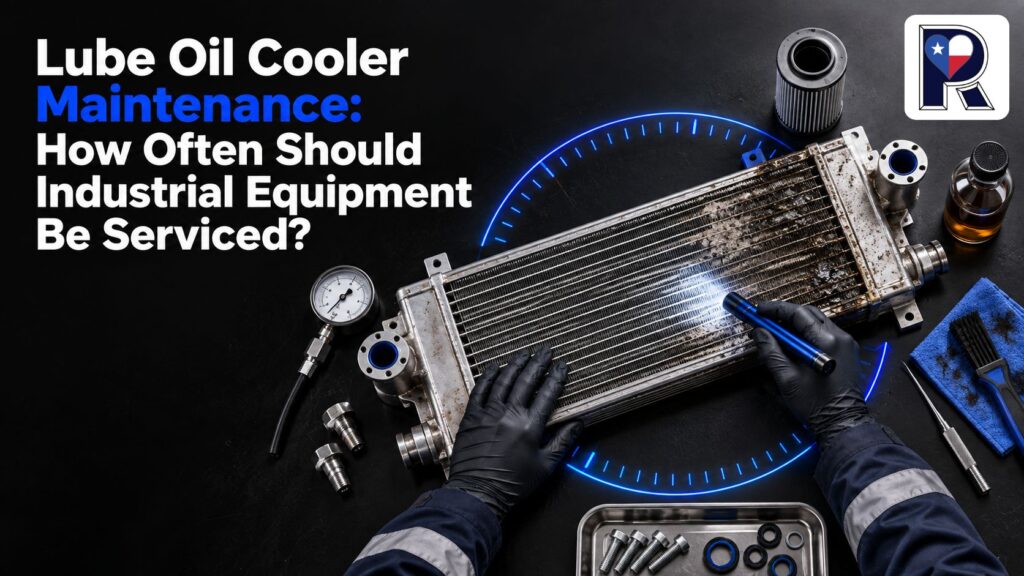
The right lube oil cooler maintenance interval is the equipment manufacturer’s scheduled interval adjusted for actual working conditions. A cooler should be inspected or serviced sooner if oil temperature begins rising, pressure drop changes, leaks appear, cooling performance falls, or contamination is found.
There is no honest one-size-fits-all answer. A lightly loaded unit in a clean facility and a frac pump working long hours in West Texas dust should not follow the same schedule simply because they use similar coolers.
How to Set a Lube Oil Cooler Maintenance Schedule
Start with the engine, compressor, gearbox, or equipment manufacturer’s service manual. That schedule establishes the minimum inspection and maintenance requirements for the complete lubrication and cooling systems.
Next, adjust the schedule using operating data. The most useful indicators include:
- Operating hours
- Normal and peak oil temperature
- Equipment load and duty cycle
- Cooler inlet and outlet temperatures
- Oil-side and water-side pressure drop
- Cooling-air or cooling-water condition
- Oil-analysis results
- Filter history
- Visible fouling, leaks, or corrosion
- Previous cooler and component failures
A calendar can tell you when the last service occurred. It cannot tell you how quickly the cooler is collecting dust, scale, sludge, or metal particles.
For that reason, oil temperature monitoring and condition-based inspections should support the manufacturer’s fixed schedule. If performance changes before the next scheduled service, waiting for the calendar date makes little sense.
In short: Use the OEM interval as the baseline, then shorten it when operating data or environmental conditions show that the cooler is losing performance.
Why Industrial Service Intervals Vary
Cooler design
Air-cooled, oil-to-water, plate-type, and shell-and-tube coolers do not collect contamination in the same way.
An air-cooled unit may lose performance when dirt blocks its fins or fan airflow. An oil-to-water cooler may develop mineral scale, biological deposits, or corrosion on the water side. Oil passages can collect sludge or debris from fluid degradation and component wear.
The correct lube oil cooler cleaning method depends on the cooler material, internal construction, and contaminant. A procedure that is safe for one unit may damage another.
Equipment load
Cooler serving equipment that runs intermittently has more time to dissipate heat between operating cycles. Continuous-duty equipment may remain near its thermal limit for hours.
If the duty cycle has increased since the equipment was commissioned, the old maintenance interval may no longer be suitable. The existing cooler may also need to be evaluated for capacity rather than cleaned repeatedly.
Ambient conditions
High outdoor temperatures reduce the temperature difference between the cooler and the surrounding air. That gives an air-cooled system less ability to reject heat.
Dust, cotton, grass, oil mist, insects, and mud can also block the core. Equipment used in oilfield, construction, mining, or agricultural work usually needs closer visual monitoring than equipment inside a clean, temperature-controlled building.
Cooling-water quality
Water-cooled units are affected by water hardness, treatment chemicals, sediment, corrosion, and biological growth. Poor water quality can cause heat exchanger fouling even when the oil remains clean.
Changes in water supply, treatment, flow, or temperature should trigger a performance review. Cleaning frequency should be based on the rate at which deposits develop, not a generic annual recommendation.
Oil condition
Oxidized oil, sludge, varnish, and wear particles can restrict narrow cooler passages. Contaminated oil may also indicate a filter problem or an internal equipment failure.
Servicing only the cooler will not solve recurring contamination. The oil, filters, reservoir, lines, and source component may all require attention.
Previous failures
A pump, bearing, gear, or other lubricated component failure can send metal and debris into the oil circuit. The cooler can trap that material and later release it into repaired equipment.
After a major component failure, inspect the cooler immediately rather than waiting for its normal service date. Depending on the contamination and core design, professional cleaning or replacement may be safer than reusing it.
In short: Cooler type, workload, heat, dust, water quality, oil condition, and failure history determine how quickly service is needed.
Practical Lube Oil Cooler Service Guidelines
The following table is a planning framework, not a replacement for the equipment manual.
Operating condition | Recommended approach | Reason |
Clean environment, stable temperatures, normal load | Follow the OEM schedule and record baseline readings | Stable data helps identify gradual performance loss |
Dusty or debris-heavy operation | Increase visual inspections and clean when airflow becomes restricted | External buildup reduces heat transfer |
Continuous or high-load operation | Monitor oil temperature during representative loads and compare readings over time | Heat-related problems may appear only under sustained load |
Untreated, hard, dirty, or changing cooling water | Track temperature difference and water-side pressure drop | Scale and deposits can restrict flow and insulate heat-transfer surfaces |
Repeated high-temperature alarms | Inspect before the next scheduled service | Waiting may expose oil and components to continued heat |
Recent pump, bearing, or internal component failure | Inspect, clean, test, or replace the cooler before returning equipment to service | Trapped debris may contaminate repaired equipment |
Seasonal equipment returning to service | Inspect for leaks, corrosion, blocked airflow, and damaged lines before full-load operation | Storage can hide deterioration until the unit becomes hot and pressurized |
Unknown maintenance history | Establish current condition through inspection and testing | A reliable schedule requires a documented starting point |
Signs the Lube Oil Cooler Needs Service Now
Do not wait for the planned interval if the equipment develops any of these symptoms.
Oil temperature is trending upward.
A single hot reading may come from unusual load or ambient conditions. A repeated increase under the same operating conditions points to a change in cooling performance or heat generation.
Compare current readings with historical data taken at similar load, speed, and ambient temperature.
Temperature reduction across the cooler has changed
The difference between inlet and outlet temperature helps indicate heat-transfer performance. The reading must be interpreted with oil flow, cooling-medium temperature, equipment load, and the cooler specification.
A manufacturer’s cooler guidance notes that fouling can be identified by monitoring inlet and outlet temperatures and pressure drop. Cleaning is appropriate when those values move significantly away from specified performance.
Pressure drop is increasing.
An abnormal cooler pressure drop may indicate restricted passages, contaminated fluid, scale, or an unsuitable fluid viscosity. It can also occur when flow exceeds the cooler’s design rating.
Pressure readings should be compared at a known flow rate and operating temperature. Cold oil is thicker and may naturally produce a higher pressure drop.
Leaks or fluid mixing are visible.
Check cooler seams, tubes, plates, fittings, hoses, gaskets, and mounting points for leakage.
On oil-to-water coolers, an internal breach may allow oil and coolant to mix. Unexplained changes in oil or coolant level, unusual fluid appearance, or an oily film in the cooling circuit require prompt investigation.
Air passages are blocked.
Dust or oily debris on the face of an air-cooled unit can hide deeper blockage. Inspect both sides of the core and the space between stacked cooling components.
Do not use uncontrolled high-pressure air or water. It may bend fins, spread contamination, or force debris deeper into the cooling package.
Equipment performance has changed.
Reduced power, abnormal noise, slow operation, unstable pressure, or repeated high-temperature shutdowns may point to a larger system problem.
A clean cooler cannot compensate for worn bearings, excessive friction, restricted oil flow, or a component generating abnormal heat.
In short: Rising temperature, abnormal pressure drop, reduced cooling, leaks, contamination, and blocked airflow justify service before the planned date.
What Does Lube Oil Cooler Service Include?
Professional lube oil cooler service should begin with inspection and testing rather than automatic replacement.
Depending on the cooler type and condition, service may include:
- Recording the unit’s identification and specifications
- Inspecting the core, housing, connections, lines, and mounting points
- Checking for external leaks, cracks, corrosion, or impact damage
- Measuring or reviewing operating temperatures
- Evaluating oil or cooling-water flow
- Checking pressure drop against the manufacturer’s specifications
- Cleaning external fins or heat-transfer surfaces
- Performing approved oil cooler flushing
- Inspecting seals, gaskets, plugs, and fittings
- Conducting oil cooler pressure testing
- Checking for internal oil-to-water leakage
- Replacing failed serviceable parts
- Retesting the cooler before it returns to service
Cleaning chemicals and methods must be compatible with the cooler’s metal, brazing, seals, and deposits. An incorrect chemical concentration or cleaning method can damage the core even when it removes the contaminant.
Operator inspection versus shop service
Operators can monitor gauges, record temperatures, look for leaks, and inspect accessible external surfaces. They should not open hot systems, disconnect pressurized lines, or improvise pressure tests.
Escaping hydraulic or lubricating oil can cause burns and injection injuries. OSHA records include serious injuries caused by high-pressure fluid escaping from damaged hydraulic lines.
Shop service is appropriate when the cooler requires removal, internal cleaning, regulated testing, leak repair, disassembly, or a repair-versus-replacement decision.
In short: A real service includes inspection, performance checks, safe cleaning, leak testing, and verification. Spraying off the visible surface is not a complete cooler evaluation.
Can a Dirty Oil Cooler Cause Overheating?
Yes. A dirty cooler can cause overheating when deposits reduce airflow, restrict oil or water flow, or insulate the heat-transfer surfaces.
However, contamination is not always the root cause. Dirt may collect on an oily core because a small leak is attracting dust. Internal debris may come from a failing bearing, pump, or filter problem.
If the cooler becomes dirty again soon after lube oil cooler cleaning, investigate how the contamination entered the system. Repeated cleaning without correcting the source wastes maintenance time and leaves the equipment exposed to another failure.
How Performance-Based Maintenance Works
Condition-based industrial cooling system maintenance uses recorded performance to decide when intervention is needed.
A basic process looks like this:
- Establish normal inlet and outlet temperatures under a repeatable load.
- Record oil pressure, cooler pressure drop, ambient temperature, and cooling-medium temperature.
- Repeat the readings during routine maintenance rounds.
- Compare new measurements with the baseline.
- Inspect or service the cooler when a consistent negative trend appears.
- Establish a new baseline after cleaning or repair.
This method works better than reacting to random temperature readings. A hot afternoon, heavier load, or different engine speed can change the numbers even when the cooler is functioning normally.
The data must be collected under similar operating conditions to be useful.
When Cleaning Is Not Enough
Cleaning may restore performance when the cooler is structurally sound, and fouling is the main problem. It cannot restore material lost to corrosion or repair a cracked plate, damaged tube, warped housing, or weakened brazed joint.
Lube oil cooler repair may be appropriate when:
- The core is structurally serviceable
- A repairable seam, tube, fitting, or connection is leaking
- Replacement seals or gaskets are available
- The cooler can be cleaned and pressure-tested successfully
- The unit still has enough capacity for the equipment
Replacement may be the more sensible option when:
- Corrosion or pitting is widespread
- The cooler repeatedly leaks after repair
- Internal contamination cannot be removed reliably
- Oil and coolant continue mixing
- The core is crushed or physically damaged
- The cooler is undersized for the current duty cycle
- Repair would cost nearly as much as a suitable replacement
- Testing cannot confirm reliable operation
The cheapest immediate repair is not automatically the least expensive decision. A cooler that fails again can contaminate the system and require another shutdown.
In short: Clean a sound cooler with removable deposits. Repair isolated, testable damage. Replace a cooler when its structure, cleanliness, capacity, or repair history makes continued service unreliable.
Building a Better Maintenance Record
A useful cooler record should include more than the date of service.
Document:
- Equipment and cooler identification
- Operating hours
- Oil type and viscosity
- Oil and filter change dates
- Inlet and outlet temperatures
- Pressure-drop readings
- Load and ambient conditions
- Cooling-water test results, when applicable
- Cleaning method and chemical used
- Leak-test or pressure-test results
- Parts and seals replaced
- Photos of deposits or damage
- Cause of contamination
- Corrective work completed elsewhere in the system
This information helps maintenance managers identify repeat problems and schedule future service before performance drops.
Lube Oil Cooler Service in San Angelo, Texas
Equipment operating around San Angelo and the Permian Basin may face sustained loads, heat, dust, and limited opportunities for downtime. These conditions make equipment-specific maintenance planning more useful than a generic annual cleaning date.
Permian Radiator provides preventive maintenance and repair for commercial and industrial lube oil coolers. The company serves the Permian Basin through locations in San Angelo, Texas, and Hobbs, New Mexico.
For lube oil cooler service San Angelo, TX, provide the shop with the cooler model, equipment information, operating hours, oil type, temperature history, and details about recent component failures. That information can help narrow the inspection and testing process.
Frequently Asked Questions
Follow the equipment manufacturer’s scheduled interval and service the cooler earlier when temperatures rise, pressure drop changes, cooling declines, leaks appear, or contamination is found.
Heavy-duty and dirty operating environments usually require closer inspection than clean, lightly loaded applications.
Industrial equipment schedules are often based on operating hours because hours better reflect equipment use. Calendar-based checks may still apply to stored, seasonal, or low-use equipment.
Use whichever requirement comes first when the manufacturer provides both.
Common signs include rising oil temperature, reduced temperature change across the cooler, increased pressure drop, blocked fins, scale, sludge, and reduced cooling-water or oil flow.
Testing is needed because worn equipment can produce similar overheating symptoms.
External surfaces may sometimes be cleaned in place if the manufacturer permits it and surrounding components can be protected. Internal cleaning depends on cooler construction, deposits, access, and approved procedures.
Do not circulate random solvents or acids through the cooler. Material incompatibility can damage seals, brazed joints, plates, or tubes.
No. Oil cooler pressure testing checks whether the cooler can hold the specified test pressure without leaking.
A cooler can pass a leak test and still have restricted passages or poor heat-transfer performance.
Yes. Internal component failures may send metal particles or other debris into the oil circuit.
The cooler should be evaluated before repaired equipment returns to service because trapped contamination may remain inside it.
Repair may be appropriate for isolated, serviceable damage when the cooler can be cleaned and successfully retested. Replacement is usually more practical when damage is widespread, contamination cannot be removed, leaks keep returning, or the cooler lacks sufficient capacity.
A shop inspection is needed to make that decision responsibly.
Schedule Service Before Cooling Performance Falls Further
Effective lube oil cooler maintenance is not about choosing an arbitrary date and ignoring the equipment until then. Start with the manufacturer’s schedule, record normal performance, and respond when temperature, pressure drop, fluid condition, or cooling efficiency begins to change.
Permian Radiator provides inspection, cleaning, testing, repair, and replacement support for industrial and commercial cooling equipment in San Angelo and across the Permian Basin. Call now to discuss your equipment, request a quote, or schedule service before a declining cooler leads to a longer shutdown.


 ICONIER Digital Marketing Agency