
Preventive radiator maintenance means keeping airflow, coolant flow, system pressure, hoses, fans, radiator cores, and related coolers in working order before overheating leads to an equipment shutdown. For commercial and industrial equipment, that usually means routine visual checks, proper coolant management, careful core cleaning, temperature monitoring, and periodic professional inspections or tests based on the machine’s OEM schedule and operating conditions.
The important part is not doing more maintenance for the sake of it. It is noticing small changes early enough to deal with them during planned service instead of when a truck, frac unit, generator, loader, or other machine is already running hot.
What preventive radiator maintenance actually includes
A radiator can only reject heat effectively when coolant can move through it, and enough air can move across its core.
That means good maintenance goes farther than checking whether the overflow tank has coolant.
A practical radiator inspection should look at:
- Coolant level and visible coolant condition
- Dirt, insects, oil, chaff, mud, and other material blocking the core
- Bent or damaged fins
- Wet areas, dried coolant residue, staining, or corrosion
- Hoses that are cracked, swollen, hardened, rubbing, or leaking
- Loose or damaged clamps and fittings
- Fan blades, fan drives, shrouds, and belts where applicable
- Radiator mounts and areas exposed to vibration
- Oil coolers, charge-air coolers, and other heat exchangers sharing the airflow path
- Operating temperatures compared with the machine’s normal baseline
Dirty cores restrict airflow, while coolant contamination, internal deposits, pressure loss, or leaks can interfere with coolant-side heat transfer. Industrial equipment working around dust and airborne debris may therefore require cleaning more often than equipment operating in a cleaner environment.
In short: Look at the complete heat-rejection path. A perfectly good radiator cannot perform properly if its airflow is blocked, the coolant is wrong, or another cooler in front of it is packed with debris.
A practical heavy equipment cooling system maintenance checklist
Maintenance works better when the checks are divided by what operators can spot quickly and what should be handled during scheduled PM.
Before or during routine operation
Operators can catch a surprising number of problems without taking anything apart.
Check for:
- An operating temperature that is higher than normal
- Coolant warnings or repeated low-level alerts
- Visible leaks under or around the equipment
- Coolant residue around connections, tanks, seams, or hoses
- Debris blocking radiator screens or accessible cooling surfaces
- Fan noise, vibration, or an obvious change in fan operation
- Unusual temperature increases during idling, pulling, lifting, pumping, or other heavy-load work
One reading by itself does not always tell you much. A temperature trend does.
If a unit normally operates within one temperature range under a known load and gradually begins running hotter under similar conditions, put that change in the maintenance record. Do not wait for the temperature alarm to become the first diagnostic clue.
During scheduled PM
A more detailed commercial radiator maintenance inspection can include:
- Cleaning accessible cooling surfaces correctly
- Inspecting fin condition and airflow paths
- Checking hoses, fittings, clamps, tanks, and seams
- Verifying fan and shroud condition
- Testing coolant when required by the equipment or coolant manufacturer
- Looking for contamination or evidence that different fluids are mixing
- Checking the radiator cap or pressure-control components where applicable
- Inspecting hydraulic, lube oil, transmission, and other coolers
- Arranging cooling system pressure testing when leakage or pressure loss is suspected
Modern heavy-duty coolant requirements vary by engine and coolant formulation. Color alone is not a reliable way to determine whether two coolant products are compatible, so fleet technicians should follow the equipment and coolant manufacturer’s specifications rather than topping off from whichever container happens to be nearby.
In short: Operators watch for changes. PM technicians inspect the system. Cooling-system specialists test what cannot be confirmed visually.
How often should industrial radiators be maintained?
There is no responsible one-size-fits-all radiator service interval for every commercial or industrial machine.
Start with the manufacturer’s maintenance schedule. Then consider shortening inspection or cleaning intervals when equipment works around:
- West Texas dust and blowing debris
- Agricultural chaff
- Oilfield contaminants
- Mud or jobsite material
- Long idle periods
- Sustained high engine load
- High ambient temperatures
- Frequent towing or hauling
- Stationary applications with limited natural airflow
Industrial radiator guidance specifically calls for increased cleaning attention in dusty agricultural and industrial environments because blocked fins reduce airflow.
A maintenance schedule should also distinguish between an inspection interval and a service interval. You may inspect a radiator frequently without needing to flush, remove, rebuild, or replace it every time.
Use condition to adjust the schedule.
Consider increasing inspection frequency when:
- Screens or fins are repeatedly becoming clogged between PM visits
- The same machine requires regular coolant top-offs
- Normal working temperature is steadily rising
- Operators report overheating only under peak load
- Hose or fitting failures are becoming recurrent
- Equipment has recently experienced a major overheating event
In short: Follow the OEM schedule as the baseline, then adapt inspections to the machine’s actual workload and environment.
Why dust, heat, and load matter in industrial radiator maintenance
A radiator does not cool equipment simply because coolant is circulating.
It needs a temperature difference and enough airflow to move heat from the radiator into the surrounding air.
That makes dirty working environments a particular problem. A layer of debris over the cooling stack acts as an airflow restriction. If an oil cooler or charge-air cooler sits in front of the radiator, material trapped between the cores can be easy to miss during a quick visual check.
High-pressure cleaning is not automatically better. Excessive pressure can bend fins or damage delicate core material, making airflow worse instead of better. Use the equipment manufacturer’s cleaning method and appropriate low-pressure air or water where specified.
Check the whole cooling stack.
This matters on equipment with several heat exchangers installed together.
For example:
- Radiator
- Charge-air cooler
- Hydraulic oil cooler
- Transmission cooler
- Engine or lube oil cooler
- Air-conditioning condenser
A clean front surface does not prove that the space between stacked cores is clean.
That is why oil cooler maintenance belongs in the same PM conversation as radiator service. Permian Radiator’s own service scope includes hydraulic oil coolers, transmission coolers, radiator repair, and related heavy-duty cooling work.
Warning signs that maintenance may have become a repair job
Cleaning and coolant checks can correct routine maintenance issues. They cannot repair a cracked core, badly corroded tank, damaged joint, or internal leak.
Have the system diagnosed when you see:
- Repeated coolant loss
- Wet seams or active leaks
- White, green, orange, or other dried residue around leak points
- Overheating that returns after external cleaning
- Significant fin or core damage
- Corrosion or pitting around tanks, joints, or fittings
- Coolant contamination
- Oil and coolant mixing
- Large temperature increases under normal load
- Repeated pressure loss
- A cooling problem that cannot be explained by visible debris
When should a radiator be pressure tested?
Cooling system pressure testing is useful when a leak is suspected but cannot be found reliably through a visual inspection.
The system is tested under controlled pressure so technicians can look for leakage from the radiator core, tanks, hose connections, fittings, or other components. Pressure testing can reveal small leaks that are difficult to see when equipment is cold and sitting idle.
Never remove a pressure cap from a hot cooling system to investigate a problem. Allow the equipment to cool and follow its service procedure.
In short: If coolant is disappearing, pressure is being lost, or overheating remains after obvious airflow problems are corrected, move from routine maintenance to diagnosis.
Cleaning, flushing, testing, rebuilding, or replacing: what does the radiator need?
Not every cooling problem requires a new radiator.
The right service depends on whether the problem is external debris, internal contamination, leakage, structural damage, or a worn-out core.
Condition | Service that may make sense | Why |
Dirt or debris blocking fins | Radiator cleaning | Restores airflow when the core itself is still sound |
Old or contaminated coolant | Cooling system flushing as specified by the OEM | Removes unsuitable fluid or deposits before correct coolant is installed |
Suspected small leak | Cooling system pressure testing | Helps locate leakage that may not be obvious visually |
Internal flow restriction | Professional inspection, cleaning, or flow testing | Determines whether internal blockage is limiting heat transfer |
Localized repairable damage | Radiator repair | May restore service without replacing the entire unit |
Worn core with reusable tanks/frame | Radiator rebuild or re-core | Can retain usable components while replacing the failed core |
Widespread corrosion or multiple failures | Replacement | Repairing one weak point may not address deterioration throughout the unit |
Can a clogged radiator be cleaned?
Sometimes.
External blockage from dust and debris can often be removed when the core is otherwise healthy. Internal scale, corrosion, oil contamination, or hardened deposits are different problems and may require professional cleaning, flow testing, or removal.
Do not assume an aggressive chemical flush or pressure washer is the answer. The radiator material, equipment design, coolant contamination, and type of blockage all matter.
When should an industrial radiator be repaired or replaced?
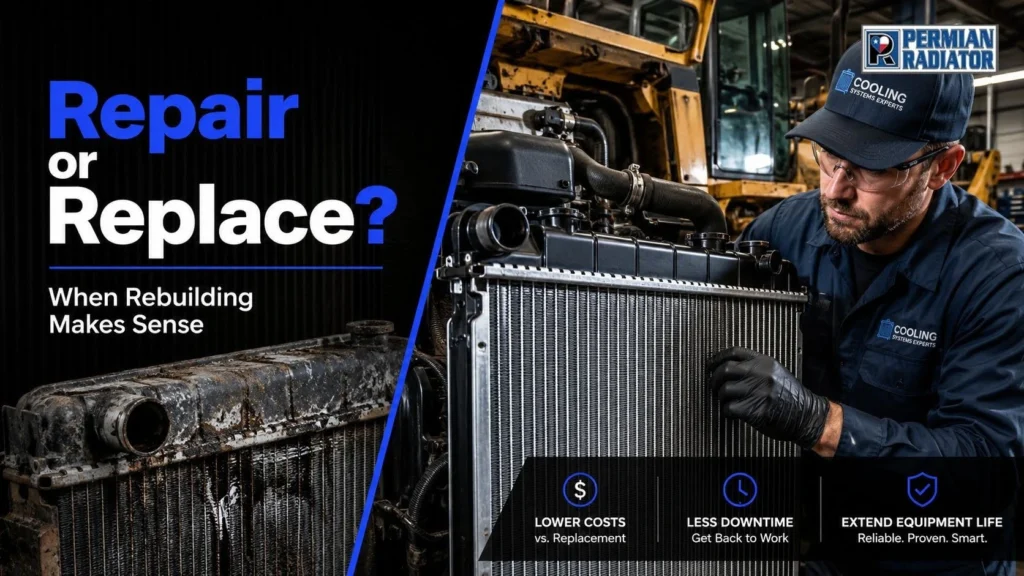
Repair or rebuilding can make sense when damage is limited, and the radiator’s main structure remains serviceable.
Replacement becomes more reasonable when deterioration is widespread, leaks occur in several areas, the core is badly damaged, or repair cannot restore dependable cooling performance. Similar repair-versus-replacement criteria are used in industrial radiator guidance.
In short: Diagnose first. Replacing a radiator that only needed cleaning wastes money; repeatedly repairing a radiator with widespread deterioration wastes downtime.
Build fleet radiator maintenance around trends, not emergencies
A PM checklist gets more useful when you record what technicians and operators actually find.
For each unit, consider tracking:
- Date and machine hours or mileage
- Coolant added and quantity
- Coolant type used
- Coolant test result where applicable
- Normal operating temperature under comparable conditions
- Core cleaning performed
- Leaks found
- Hose or clamp repairs
- Pressure or flow test results
- Radiator or cooler repairs
- Previous overheating incidents
Maintenance records help separate random one-off events from recurring patterns.
For example, a truck needing a small coolant top-off once after service may not tell you much. The same truck repeatedly needing coolant every few weeks deserves investigation even if nobody sees a puddle.
Likewise, a loader that always runs slightly hotter during peak summer work may be operating normally. A loader that begins running noticeably hotter than its own historical baseline under the same workload gives you a reason to inspect the cooling package before an alarm occurs.
That is the practical goal of overheating prevention: catch deterioration while you still control when the equipment comes out of service.
Preventive cooling-system service in San Angelo
Equipment around San Angelo can see demanding combinations of dust, heat, long operating hours, hauling, construction work, agricultural use, and oilfield duty.
For maintenance managers, that makes industrial radiator maintenance in San Angelo, TX less about following a generic calendar and more about knowing what each machine is exposed to.
Permian Radiator handles commercial, industrial, heavy-duty, and automotive cooling systems, with services including radiator repair, replacement and rebuilding, hydraulic oil cooler repair, lube oil cooler service, transmission cooler repair, and cooling-system maintenance. Its Texas location is in San Angelo, with another location in Hobbs serving broader Permian Basin operations.
A shop visit is particularly useful when the maintenance crew needs:
- Commercial radiator repair San Angelo
- Heavy-duty radiator repair San Angelo
- Radiator rebuild San Angelo
- Professional leak diagnosis
- Cooler inspection and repair
- Cleaning beyond routine exterior maintenance
- Pressure or flow testing
- Help deciding whether repair, rebuilding, or replacement makes sense
The point is not to send every dirty radiator to a shop. Handle routine inspections and safe cleaning within your PM program. Bring in a cooling-system specialist when the condition cannot be verified or corrected confidently in-house.
In short: Routine PM should prevent unnecessary shop visits. Proper diagnosis should prevent unnecessary parts replacement.
Keep small cooling problems on the maintenance schedule
Good preventive radiator maintenance does not mean replacing parts early. It means knowing what normal looks like, keeping the cooling package clean, using the correct fluids, documenting changes, and investigating problems before a temperature warning becomes the first sign that something is wrong.
For fleets, oilfield equipment, construction machinery, commercial trucks, and industrial equipment around San Angelo and the Permian Basin, that approach gives maintenance managers more control over when cooling-system work happens.
If your equipment is showing rising temperatures, recurring coolant loss, restricted airflow, leaks, or a radiator or oil cooler that needs more than routine maintenance, contact Permian Radiator.
Call now, request a free quote, or schedule service to have the cooling system inspected and determine whether cleaning, repair, rebuilding, or replacement is the right next step.
FAQ
Keep the core and surrounding coolers clear of debris, use the correct coolant, inspect hoses and connections, check fans and airflow components, watch for leaks, and compare operating temperatures with the machine's normal baseline.
Follow the equipment manufacturer's inspection, coolant-testing, flushing, and replacement schedule.
Common causes include restricted airflow, dirty radiator fins, internal coolant-flow restriction, coolant loss, incorrect or contaminated coolant, fan problems, damaged hoses, pressure loss, and radiator or cooler damage.
Overheating can also come from components outside the radiator, so diagnosis should cover the complete cooling system.
Follow the machine manufacturer's procedure.
Where low-pressure air or water is permitted, remove material without folding or crushing the fins. Avoid getting a pressure-washer nozzle close to a radiator core unless the manufacturer specifically provides an approved procedure for doing so.
Not unless the equipment and coolant manufacturers confirm compatibility.
Modern heavy-duty coolants can use different additive packages, and coolant color by itself does not reliably identify chemistry.
No.
The exterior can look clean while internal passages are restricted, a small pressure leak is present, coolant chemistry is poor, or another heat exchanger in the cooling stack is blocked.
Yes, when they are part of the equipment's cooling package.
Debris on a hydraulic or oil cooler can restrict airflow before it even reaches the radiator, while internal cooler problems can raise fluid temperatures independently.
Stop assuming dirt is the only cause.
Check coolant level and condition, fans, belts where applicable, hoses, airflow, pressure loss, coolant circulation, oil coolers, and other components. If the cause is not clear, professional inspection and testing are safer than repeatedly cleaning or replacing parts at random.


 ICONIER Digital Marketing Agency