
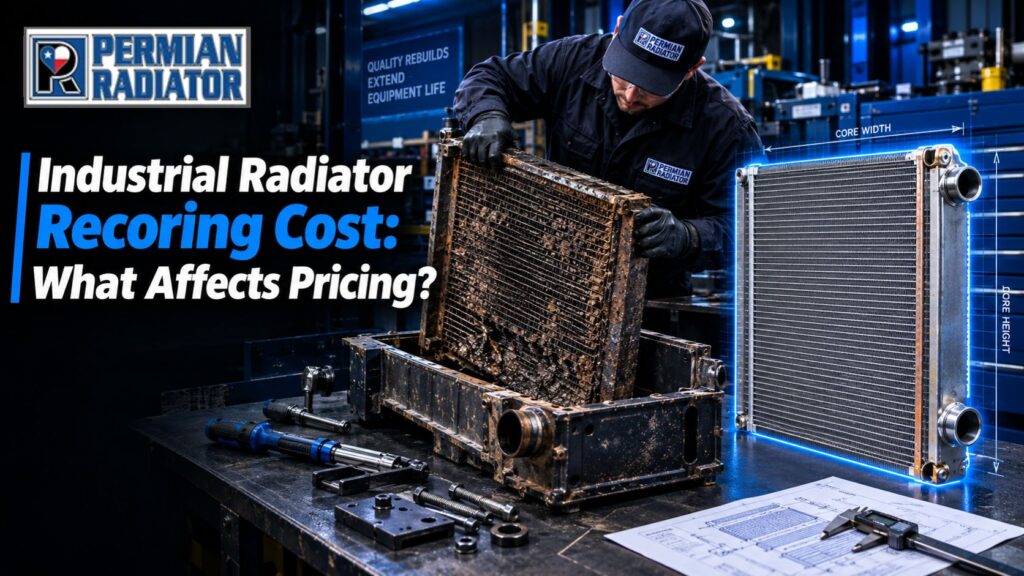
Industrial radiator recoring cost depends on the replacement core’s specifications, the condition of reusable components, labor, fabrication, testing, and whether removal and installation are included. A reliable estimate starts with identifying the radiator and inspecting what can be retained. A generic price range is unlikely to describe the actual work required for a specialized industrial assembly.
Two radiators with similar outside dimensions can need different cores, materials, and assembly work. Before comparing prices, make sure each quotation describes a suitable core and the same service scope.
What Are You Paying for When a Radiator Is Recored?
Recoring replaces the radiator’s heat-transfer core while retaining serviceable parts of the original assembly. Depending on the design, these may include tanks, frames, brackets, and connections.
The job can involve disassembly, cleaning, inspection, fitting the new core, repairing retained components, reassembly, and testing. A quote for a loose replacement core covers much less work than a completed radiator ready for installation.
Recoring also differs from repairing an isolated leak. If you are still deciding which approach suits the damage, review industrial radiator repair versus replacement before comparing detailed estimates.
The Main Factors That Change Radiator Recore Pricing
Core Dimensions and Construction
The replacement radiator core must suit the equipment’s cooling requirements and available space. Face dimensions, depth, tube configuration, and fin design affect the component required.
A quotation based only on overall height and width can miss important differences. Part numbers, drawings, photographs, and identification of the equipment help establish a useful starting specification.
Core Materials and Repair Method
Copper-brass and aluminum assemblies use different construction and joining methods. Material choice affects sourcing and the practical rebuilding process, but material alone does not establish which option is appropriate.
Specify a compatible assembly for the required coolant, pressure, mounting arrangement, and operating environment. A proposed material change should be assessed for the application rather than presented as an automatic upgrade.
Condition of Tanks and Supporting Structure
Reusing sound parts can make recoring worthwhile. Cracked tanks, damaged connections, corroded supports, or distorted mounting points can add repair or fabrication work.
Some damage becomes apparent only after disassembly and cleaning. Ask which parts of the initial estimate are provisional and how additional findings will be documented before the work proceeds.
Availability and Custom Fabrication
A readily available core and a custom-built replacement may have different prices and lead times. An older radiator can require additional identification work, while an unusual application may need dimensions confirmed from the original unit.
Availability matters to the overall decision. Ask when the correct core can be supplied and which work can begin while it is being sourced. Do not assume that a quoted production time includes transport, assembly, and testing.
Removal, Installation, and Access
A radiator delivered loose to a workshop is a different job from a complete equipment repair. Access can involve guards, pipework, hoses, adjoining coolers, and lifting arrangements.
Clarify who is responsible for removal and installation. Also establish whether coolant, disposal, seals, hoses, transport, and any lifting work are included or separately arranged. This avoids comparing a bench-only quotation with one covering substantially more work.
Testing and Final Preparation
Ask what the completed assembly will be checked for and which results will be recorded. Leak integrity, correct fitment, and suitable cooling specifications are different considerations.
Manufacturer industrial radiator maintenance guidance treats structural condition, coolant contamination, leaks, and airflow as relevant service concerns. A new core does not remove problems elsewhere in the cooling system.
Compare Estimates Using the Same Scope
Quote item | What to confirm |
Replacement core | Dimensions, construction, material, and application compatibility |
Retained components | Which tanks, mounts, brackets, and connections will be reused |
Repair allowance | Included repairs and treatment of additional damage |
Labor | Whether pricing is for bench work or includes equipment installation |
Testing | Checks included and documentation available |
Consumables and freight | Coolant, seals, transport, disposal, and other charges |
Completion estimate | Parts availability plus assembly and testing time |
Warranty | Written scope, exclusions, and any operating requirements |
If one estimate is much lower, ask what is different before assuming it offers the same repair. The difference may be legitimate, such as a stock core or a smaller work scope, but it should be clear.
Consider Downtime Without Relying on Guessed Savings
Equipment downtime can affect the practical value of a repair. Use your own rental rates, transport expenses, crew arrangements, and production commitments when comparing options. Do not apply another company’s daily downtime figure to your operation.
An illustrative comparison might involve one option with a shorter parts lead time but more assembly work, and another with a longer delivery window for a complete unit. The better choice depends on the confirmed completion dates and your actual operating costs.
There is no universal percentage that makes recoring cheaper than replacement. It depends on what can be reused and the cost and availability of a suitable alternative.
Prepare a Useful Quotation Request
Provide the equipment make and model, engine identification where relevant, radiator or core number, photographs, dimensions if available, and a description of the failure. Explain whether the assembly is removed and when the equipment is needed.
Include previous repairs, coolant contamination, and any change in operating duty. Those details help the shop assess whether the original specification remains suitable.
For San Angelo and Hobbs operations, confirm transport and handover arrangements when requesting the estimate. An equipment-specific inspection may still be necessary before firm pricing is available.
Frequently Asked Questions
Photographs can support identification and preliminary discussion. Hidden corrosion, tank condition, and the exact core specification may still require physical inspection before a firm estimate.
No. Recoring can offer value when reusable components are sound. Extensive additional repairs or a readily available complete replacement can change the comparison.
Some aluminum designs can be rebuilt or recored using suitable processes. Others are less practical to restore. Construction, damage, component availability, and the repair facility’s capabilities determine the options.
Not automatically. A different core must work with the fan, airflow path, coolant flow, and available space. Choose a specification supported by the application’s cooling requirements.
Request an Estimate for Your Industrial Radiator
Permian Radiator provides radiator repair and rebuilding services for commercial and industrial customers in San Angelo, TX, and Hobbs, NM. An inspection can help establish which components remain serviceable and which repair options deserve pricing.
Request a radiator rebuilding quote or call 575-631-5246. Send the equipment details and radiator photographs, and ask for a written scope covering parts, labor, testing, and expected completion.


 ICONIER Digital Marketing Agency