
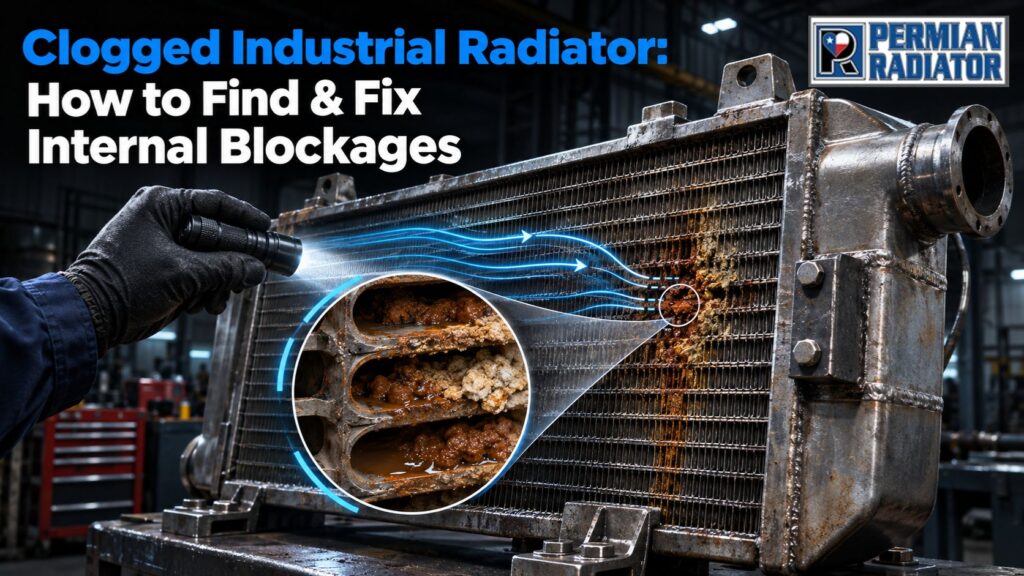
A clogged industrial radiator can restrict coolant flow or reduce heat transfer when scale, corrosion debris, sludge, or other deposits collect inside its passages. Confirming an internal blockage requires more than observing a hot engine: check coolant condition, rule out circulation and airflow faults, and assess radiator flow against suitable specifications. Cleaning may restore a sound core, while severe restriction or deterioration can require recoring or replacement.
The outside of the radiator can look clean while its internal condition remains poor. Equally, an overheating machine can have a serviceable radiator and a problem elsewhere. A careful diagnosis prevents unnecessary replacement and repeated flushing that never addresses the cause.
What Collects Inside an Industrial Radiator?
Mineral Deposits From Unsuitable Water
Water quality matters wherever a coolant concentrate must be mixed. Mineral content outside the engine manufacturer’s requirements can contribute to scale on cooling-system surfaces. Deposits interfere with heat transfer and may narrow passages.
Use the specified water quality and coolant concentration. Switching to another coolant color does not establish compatibility or remove existing deposits.
Corrosion Debris and Accumulated Sediment
Corrosion products can circulate from other parts of the cooling circuit and collect in the radiator. Repeatedly cleaning one component while leaving a contaminated circuit untreated can allow sediment to return.
Industrial radiator maintenance guidance recognizes that internal scale may require attention to the entire closed cooling circuit. The cleaning method must suit the construction and the deposits present. See the radiator maintenance technical bulletin.
Oil Contamination or Unsuitable Additives
Oil entering the coolant can leave deposits, but the source must be identified. Depending on the equipment, an internal heat-exchanger leak or an engine fault may require investigation. A flush cannot repair that leak.
Record any sealant or other additive previously introduced. The technician needs to know what may be inside the system before choosing cleaning chemistry.
Signs That Justify an Internal Blockage Inspection
A gradual rise in operating temperature, rusty coolant, visible sediment, or repeated overheating despite an open airflow path can justify further investigation. Reduced performance under sustained load is another useful observation.
These signs are not exclusive to blockage. Low coolant, a thermostat that does not open correctly, a water-pump problem, trapped air, or poor fan performance can produce similar complaints.
Do not keep opening a hot system to check coolant. Shut down according to the equipment procedure, let it cool, and isolate the machine before service.
How to Confirm an Internal Radiator Restriction
Start With Coolant Condition and Service History
Check the specified coolant, previous fill practices, contamination history, and recent repairs. Take a representative sample when analysis is warranted. Appearance can reveal a reason to investigate, but clear-looking fluid does not establish correct chemistry.
Coolant analysis guidance describes checking chemical balance, fluid condition, contamination, and freeze/boil protection. Those findings help determine whether radiator cleaning alone would be sufficient.
Interpret Temperature Readings in Context
A technician may compare inlet and outlet readings and examine the temperature pattern across the core under controlled conditions. Uneven temperatures can support a restriction diagnosis, but readings also depend on coolant flow, thermostat position, airflow, load, and the measurement surface.
There is no single inlet-to-outlet temperature difference that proves every industrial radiator is blocked. Compare observations with the equipment requirements and other test results.
Use Flow Assessment to Investigate Circulation
Where the radiator design and test facilities allow it, a flow test can help evaluate restriction. Results need an appropriate reference for that assembly and test setup. Simply observing some water pass through the radiator does not prove it can carry the required operating flow.
Check the rest of the coolant path too. Restricted hoses or other circuit faults can limit circulation through a radiator that is itself serviceable.
Keep Pressure Testing Separate From Flow Testing
A pressure test looks for leakage under specified test conditions. It does not demonstrate that all coolant passages are open or that the radiator rejects enough heat.
A core can hold pressure and still have an internal blockage. For more detail, read what a radiator pressure test can reveal.
Choose a Cleaning Method That Matches the Deposit
Finding | Possible service approach | Required follow-up |
Removable loose sediment | Approved draining and flushing procedure | Confirm the circuit is clean and cooling performance is acceptable |
Scale in an otherwise serviceable core | Compatible professional descaling | Check flow and leak integrity after cleaning |
Oil contamination | Repair the contamination source and clean affected components | Verify the source is corrected and contamination does not return |
Severe deposits with deteriorated tubes | Assess recoring or replacement | Confirm retained parts and replacement specifications are suitable |
Cleaning chemistry must be compatible with the core, tanks, soldered or brazed joints, seals, and equipment requirements. Avoid household chemicals or an improvised acid mixture. Stronger chemistry can damage an assembly without restoring dependable performance.
Some designs allow disassembly for more direct access; others do not. Mechanical tube cleaning is also design-dependent. The repair shop should explain the practical options after identifying the unit.
After cleaning, check for leaks and verify that flow and operating performance have improved. If cleaning exposes previously deteriorated material, additional repair may be necessary. Refill and vent the system using the engine manufacturer’s procedure.
Keep the Restriction From Returning
Correct the contamination source, use the specified coolant, and maintain service records. Repeated water-only additions deserve investigation because they dilute protective additives and can conceal ongoing fluid loss.
For fleets, record what was found inside the radiator and how the condition was verified after service. “Flushed” is less useful history than a record identifying the deposit, corrective work, and final checks.
Frequently Asked Questions
Yes. Deposits attached inside the core may remain after the circulating fluid has been changed. Coolant appearance alone cannot establish that the passages are clear.
Not necessarily. Replacing fluid removes drained coolant, while attached deposits may require a compatible cleaning process. The equipment and deposit type determine whether descaling is appropriate.
Yes. Reduced cooling performance may become noticeable when heat input increases. That pattern also occurs with airflow and circulation faults, so it needs testing rather than an immediate replacement decision.
Ask which checks will verify the result. Depending on the assembly, these may include flow assessment, leak testing, coolant checks, and operation under representative conditions. Appearance alone is insufficient.
Schedule an Industrial Radiator Inspection
Permian Radiator offers radiator inspection, cleaning, flushing, repair, and rebuilding services for commercial and industrial customers. Equipment owners in San Angelo, TX, Hobbs, NM, and nearby operating areas can discuss a suspected internal blockage before deciding on further repairs.
Schedule radiator service or call 575-631-5246. Provide the equipment model, coolant history, symptoms, and any previous flushing results.


 ICONIER Digital Marketing Agency