
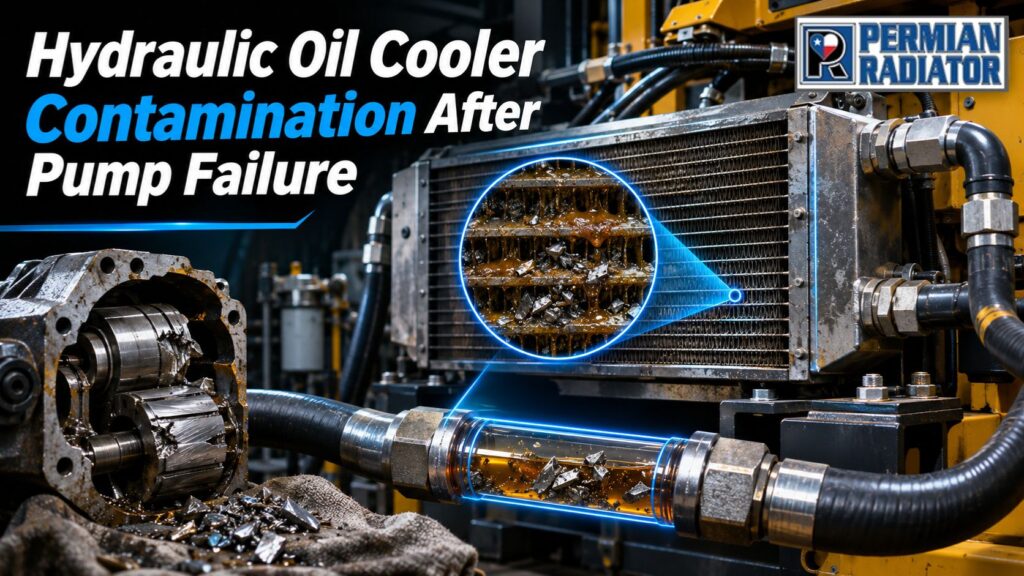
Hydraulic oil cooler contamination after pump failure occurs when wear debris, broken component material, or degraded fluid reaches the cooler through the hydraulic circuit. Debris can remain inside narrow passages after the reservoir oil is changed. Before restarting, determine whether the cooler can be cleaned and verified to the equipment’s requirements or must be replaced as part of the system recovery.
Installing a replacement pump does not establish that the remaining circuit is ready for service. The cooler, hoses, valves, reservoir, and other affected components need to be considered together. The extent of that work depends on the failure and the machine’s hydraulic layout.
How Pump Failure Contaminates a Hydraulic Cooler
When internal pump parts wear heavily or break, debris may travel with the oil. Which components receive it depends on the circuit, filter positions, bypass arrangements, and the way the failure developed.
The oil cooler deserves particular attention because its internal passages and headers may retain material. A cooler can therefore become a possible source of contamination after the visibly failed component has been removed.
Do not assume that every contaminated system had dirty oil before the breakdown. Failure debris can be a consequence of the original fault. Accurate failure analysis should distinguish the initiating problem from damage that followed it.
Why a Reservoir Drain Leaves Questions Unanswered
Draining the tank does not remove all the fluid retained throughout the machine. Oil and particles may remain in components, hose runs, filter housings, and low-flow sections.
A flushing plan must account for the actual circuit. It should specify which components are isolated, cleaned separately, inspected internally, or replaced. Simply circulating fresh oil through every component can move contamination into areas that were previously clean.
Hydraulic flushing guidance emphasizes that contamination can remain in coolers, lines, and other circuit components, and that circulating fluid may not safely remove all trapped deposits.
Inspect the Cooler Before Deciding to Reuse It
Identify the Design and Applicable Requirements
Obtain the cooler model, operating limits, circuit position, fluid type, and equipment service instructions. Air-cooled and water-cooled units can have very different internal construction and access.
Some designs allow more direct inspection or disassembly than others. Confirm whether the manufacturer provides a post-failure cleaning procedure or requires replacement after a particular contamination event.
Document the Type and Extent of Contamination
Preserve useful failure evidence before cleaning. The hydraulic service team may need samples, filter findings, photographs, and information from the failed pump.
Visible metal, damaged seals, persistent debris discharge, or recurring contamination after attempted cleaning can change the reuse decision. Oil analysis and particle counting answer different questions; the test plan should match what investigators need to establish.
Check Condition and Restriction Separately
Inspect the cooler for leaks, damaged connections, corrosion, and physical damage. Evaluate flow resistance where an appropriate test is available.
Pressure drop must be interpreted at a known flow and fluid condition. Cold, more viscous oil can produce different readings from warm oil. A useful comparison therefore needs the cooler’s performance information or another suitable reference, rather than a universal pressure-drop limit.
Cleaning Versus Replacement After Pump Failure
Condition | Decision to discuss |
Manufacturer permits cleaning, and results can be verified | Consider a controlled cleaning process with documented acceptance checks |
Severe debris contamination and inaccessible internal passages | Assess replacement, especially when cleanliness cannot be demonstrated |
Persistent particles after repeated approved cleaning | Investigate remaining contamination and whether continued cleaning is practical |
Cracked core, internal leakage, or major structural damage | Assess repair feasibility or replacement independently of contamination |
Cooler condition is acceptable, but the rest of the circuit remains contaminated | Complete the wider recovery before reconnecting the cleaned component |
When Cleaning May Be a Reasonable Option
Reuse may be practical when the manufacturer permits an effective cleaning method, the cooler remains structurally sound, and the required condition can be demonstrated afterward.
The process must use compatible fluids and remain within the component’s pressure, temperature, and flow limitations. Reverse-flow cleaning may be appropriate for some units, but it should not be assumed suitable for every cooler or attached valve arrangement.
When Replacement Deserves Priority
Replacement deserves serious consideration when the equipment manufacturer requires it, internal damage exists, or trapped debris cannot be removed and verified acceptably. Repeated attempts to clean an inaccessible core can consume time without providing confidence in the result.
A structurally serviceable cooler can still be unsuitable for reuse after a severe contamination event. Conversely, contamination alone does not establish that every cooler design must always be discarded. The decision needs evidence and equipment-specific requirements.
What Should Be Verified Before Restart?
Cleanliness Must Meet the System’s Requirement
Use the cleanliness target specified for the equipment and its sensitive components. ISO 4406 provides a way to report particle contamination; it does not prescribe one universally acceptable code for all hydraulic systems.
Manufacturer contamination-control guidance recommends setting an appropriate target, selecting filtration to achieve it, and monitoring results. Sample location and method matter when deciding whether the recovered system is ready.
Leak Integrity Does Not Prove Cleanliness
A pressure test can establish whether the cooler leaks under the test conditions. It cannot demonstrate that internal passages are free of damaging particles. Flow assessment, cleanliness verification, and leak testing address separate concerns.
Likewise, clear-looking hydraulic oil can contain particles too small to see. Visual inspection is useful for obvious problems but cannot replace required testing.
Restart Should Follow the Equipment Procedure
The responsible hydraulic technician should confirm that the failure cause has been addressed and the affected circuit is ready. Follow the specified filling, bleeding, startup, filter-service, and monitoring requirements.
Avoid adopting a fixed flushing duration or a generic number of filter changes from another machine. Completion should be based on the agreed requirements and documented findings.
Keep Cooler Service Coordinated With the Hydraulic Repair
Before sending the cooler out, tell the repair facility that a pump failed. Include the failure details, fluid type, cooler identification, contamination findings, and any cleaning already attempted. Explain the acceptance requirements set by the equipment owner or manufacturer.
A useful cooler-service report should clarify what was inspected, what work was completed, and which conditions were verified. Full-system cleanup and pump commissioning remain part of the wider hydraulic repair plan.
Frequently Asked Questions
No universal rule covers every system. The failure severity, contamination path, cooler construction, manufacturer’s instructions, and ability to verify cleaning determine whether reuse is reasonable.
No. Cleaning the fins restores the outside airflow path. Internal oil-side contamination requires a separate assessment and an appropriate cleaning or replacement decision.
A new filter does not establish that trapped debris has been removed from the entire circuit. Filter position, bypass conditions, retained contamination, and the manufacturer’s recovery procedure all matter.
Yes. A leak-free cooler may still contain retained particles. Pressure testing evaluates integrity under test conditions, while cleanliness requires separate verification.
Arrange an Inspection for a Contaminated Hydraulic Cooler
Permian Radiator provides hydraulic oil cooler repair and inspection for customers in San Angelo, TX, Hobbs, NM, and surrounding areas. Discuss the pump failure and the cooler’s condition before assuming it can be returned to service.
Request a hydraulic oil cooler assessment or call 575-631-5246. Provide the cooler details and contamination history so the team can discuss appropriate service options alongside your hydraulic repair provider.


 ICONIER Digital Marketing Agency