
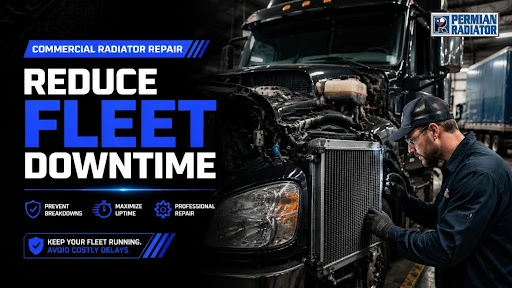
A good commercial radiator repair strategy reduces fleet downtime by catching leaks, airflow restrictions, contamination, and overheating problems before they leave a truck or machine out of service. For fleet managers, the goal is not simply to repair a radiator faster. It is to identify cooling-system trouble early, schedule service before failure, and choose the right repair, rebuild, or replacement option without wasting shop time.
That matters even more for commercial trucks, construction equipment, oilfield machinery, and other equipment operating under heavy loads. A small cooling problem that could have been handled during planned maintenance can turn into an overheated engine, disabled machine, towing expense, or missed job if it is ignored.
How commercial radiator repair reduces fleet downtime
The radiator removes heat from engine coolant before that coolant returns to the engine. When airflow, coolant circulation, or heat transfer is restricted, engine temperature can climb quickly.
Professional commercial radiator repair focuses on finding the reason the cooling system is losing efficiency instead of simply treating the visible symptom.
Depending on the equipment and problem, that may involve:
- Finding external or internal leaks
- Performing radiator pressure testing
- Cleaning blocked radiator cores
- Checking coolant flow
- Inspecting hoses, clamps, caps, and connections
- Looking for corrosion or damaged fins
- Checking for contamination
- Repairing damaged sections when practical
- Rebuilding or replacing the radiator when repair no longer makes sense
A fleet gains more from an accurate diagnosis than from repeatedly topping off coolant or replacing parts based on guesses.
In short: planned diagnosis and repair usually create less disruption than waiting until overheating forces a truck or machine out of service.
Why cooling-system problems cause so much fleet downtime
Radiator problems rarely stay isolated.
A minor coolant leak can gradually reduce the system’s ability to control temperature. A clogged radiator can restrict airflow. A damaged hose can turn a slow seep into a rapid coolant loss.
Once temperatures rise, the operator may have no practical option except shutting the equipment down.
That creates several problems at once:
- The vehicle or machine becomes unavailable.
- Drivers or operators may be left waiting.
- Loads, jobs, or production schedules may need to be reassigned.
- Emergency transportation or towing may be required.
- A repair that could have been scheduled now becomes urgent.
- Continued overheating may damage components beyond the radiator itself.
This is why preventive maintenance should treat the cooling system as an operating system, not simply as one radiator sitting at the front of the engine.
For industrial machinery, the same principle applies beyond engine coolant. Transmission and hydraulic systems also depend on heat exchangers to keep fluid temperatures under control.
In short: reducing downtime means identifying heat-management problems before they become equipment failures.
What are the signs of radiator problems in heavy-duty equipment?
Operators are often the first people who notice a change.
Training drivers and equipment operators to report small abnormalities can give the maintenance team time to act before a breakdown.
Watch for these warning signs:
Temperature running higher than normal
A machine does not need to be fully overheating before it deserves attention. A temperature gauge that consistently runs higher under loads that previously caused no problem can indicate declining cooling performance.
Coolant appearing under the equipment
Visible coolant deserves investigation even when the leak seems small.
Leaks may come from the radiator itself, but hoses, fittings, clamps, caps, tanks, water pumps, and other cooling-system components can also be responsible.
Coolant needs frequent topping off.
Adding coolant repeatedly is not routine maintenance. It indicates that coolant is going somewhere.
The source should be identified rather than allowing refilling to become part of the operating routine.
Damaged, dirty, or blocked radiator fins
Mud, dust, insects, plant material, and job-site debris can restrict airflow through the radiator core.
Cleaning must also be done correctly. Aggressive pressure against delicate fins can bend them and create another airflow problem.
Steam or coolant odor
Steam, visible vapor, or a noticeable coolant odor can indicate a leak or overheating condition that needs immediate attention.
Temperature problems under load
A truck may appear normal while idling yet start running hot while hauling, climbing, operating PTO equipment, or working under sustained load.
That pattern is useful diagnostic information and should be reported to the repair shop.
In short: do not wait for the temperature warning light. Changes in coolant level, temperature behavior, leakage, airflow, or smell can provide earlier warning.
How to reduce fleet downtime with a cooling-system maintenance plan
The most effective approach is fairly simple: inspect frequently, document what changes, and schedule repairs before the equipment becomes unusable.
1. Add radiator checks to routine inspections
A basic cooling system inspection should look beyond the radiator core.
Check:
- Coolant level when safe and appropriate
- Radiator and coolant reservoir
- Hoses and connections
- Hose clamps
- Radiator cap condition
- Visible leaks or staining
- Bent or blocked fins
- Dirt and debris restricting airflow
- Signs of corrosion
- Unusual temperature readings
Drivers do not need to diagnose the failure themselves. Their job is to spot and report changes.
2. Adjust maintenance to actual equipment use
A truck running predictable highway miles does not experience the same conditions as a loader working all day in dust or oilfield equipment operating under high load.
Build radiator maintenance around:
- Engine hours
- Mileage
- Load
- Operating temperature
- Environment
- Previous failure history
- Manufacturer recommendations
This is more useful than applying one arbitrary service interval to every asset.
3. Keep radiator cores clean
Good airflow is necessary for heat transfer.
Schedule radiator cleaning more frequently when equipment operates around dirt, dust, vegetation, debris, or other material that can collect in the cooling stack.
Do not assume the front surface tells the whole story. Multi-layer cooling packages may collect debris between the radiator, charge-air cooler, condenser, and oil cooler.
4. Investigate small leaks promptly
One of the easiest ways to turn a planned repair into unplanned downtime is to keep operating with a known leak.
Use radiator pressure testing when appropriate to help locate leakage that may not be obvious during a quick visual inspection.
5. Record temperature-related complaints
“Runs hot” is not enough information.
Ask the driver or operator:
- Does it happen at idle or under load?
- Does it happen only during long pulls?
- Does ambient temperature affect it?
- Is coolant being lost?
- Does the heater behave differently?
- Did the problem appear suddenly or gradually?
- Was any recent cooling-system work performed?
Those details can shorten the diagnostic process.
6. Schedule service around low-demand periods
If a unit has a known developing problem, waiting for failure gives the equipment control of your schedule.
Planned service allows the fleet manager to choose the least disruptive time to remove that asset from operation.
7. Track repeat cooling-system problems
If the same vehicle keeps returning for overheating, leakage, or cooling-system contamination, stop treating each visit as an unrelated event.
Review its repair history.
Recurring failures may indicate that a radiator rebuild, cooling-system cleaning, component replacement, or broader diagnosis is more sensible than another temporary repair.
In short: the biggest downtime savings usually come before the repair begins. Early reporting and planned service give the maintenance team options.
Should you repair, rebuild, or replace a commercial radiator?
There is no correct answer for every radiator.
The decision should consider damage, contamination, radiator construction, parts availability, equipment value, repeat failure history, and how quickly the unit needs to return to operation.
Option | Often makes sense when | Downtime consideration | Main tradeoff |
Repair | Damage is localized, and the radiator remains serviceable | May provide the shortest path back to service | Not appropriate when deterioration is widespread |
Radiator rebuild | The assembly can be restored, and replacement is not the most practical choice | Can preserve an existing configuration while correcting broader core problems | Requires more work than a small repair |
Radiator replacement | The radiator is severely damaged, badly deteriorated, repeatedly failing, or uneconomical to repair | Can avoid repeatedly removing the same unit from service | Parts availability can affect turnaround |
When should a commercial radiator be repaired?
Repair generally makes sense when the failure is limited enough that the existing unit can be returned to reliable service without repeatedly addressing the same deterioration.
When does rebuilding make more sense?
A rebuild may be worth considering when the tanks or structure remain usable, but the core or other serviceable sections have deteriorated.
This is especially relevant for equipment where radiator assemblies are large, specialized, expensive, or difficult to source.
Repair or replace a commercial radiator?
Replacement becomes more attractive when damage is extensive, corrosion is widespread, the unit has failed repeatedly, or repair costs are approaching the value of a dependable replacement.
The cheapest invoice today is not automatically the lowest-downtime choice.
If a repaired unit is likely to return to the shop soon, replacement may be the better operating decision.
In short: evaluate the whole service history, not just today’s leak.
Don’t overlook oil coolers and transmission coolers
Commercial and industrial equipment often has several heat exchangers working together.
That means an overheating complaint may involve more than the engine radiator.
Hydraulic oil cooler repair
Hydraulic systems generate heat as equipment operates.
A restricted, contaminated, damaged, or leaking hydraulic cooler can allow fluid temperatures to rise. That can affect hydraulic performance and put additional stress on pumps, seals, hoses, and other components.
For construction and oilfield equipment, hydraulic oil cooler repair may therefore be part of the same downtime-prevention strategy as radiator service.
Transmission fluid cooler repair
Heavy loads and demanding operating conditions also create transmission heat.
Leaks, restrictions, or internal cooler problems can reduce the system’s ability to control fluid temperature.
Professional transmission fluid cooler repair should also check whether fluid contamination or cross-contamination has occurred rather than focusing only on the visible leak.
A cooling-system specialist that handles these related components can make troubleshooting easier when a fleet contains a mix of trucks, industrial machinery, and heavy equipment.
How San Angelo operating conditions affect radiator maintenance
Fleet maintenance should reflect where and how the equipment works.
San Angelo and other parts of West Texas can expose commercial vehicles and machinery to high ambient temperatures, dust, debris, long operating hours, heavy loads, and demanding industrial or oilfield duty cycles.
Those conditions can make airflow and coolant condition especially worth watching.
For commercial radiator repair in San Angelo, TX, fleet managers should pay particular attention to:
- Debris collecting in cooling cores
- Cooling performance during high-load operation
- Repeated coolant loss
- Hose deterioration
- Corrosion
- Higher-than-normal operating temperatures
- Equipment that overheats only during demanding work
A calendar-only maintenance plan may miss these differences.
A better strategy combines manufacturer recommendations with the actual duty cycle of each truck or machine.
For companies searching for heavy-duty radiator repair San Angelo or fleet radiator repair San Angelo, bringing service history and operating information to the repair shop can also make diagnosis more efficient.
In short: maintenance intervals should reflect operating conditions, not just the date on the calendar.
What should you tell the radiator shop before service?
This is one of the simplest ways to reduce repair delays.
Before bringing in a commercial truck, industrial radiator, cooler, or heavy-equipment component, gather as much of the following information as possible:
- Equipment make and model
- Engine or equipment application
- Unit or fleet number
- Symptoms
- Temperature readings if available
- Where fluid appears to be leaking
- How quickly coolant or fluid is being lost
- Whether the problem occurs under load
- Previous radiator or cooling-system repairs
- Recent coolant service
- Any contamination noticed
- Whether the equipment is currently operable
- Your operational deadline
Pictures can also help when discussing large industrial radiators or unusual assemblies.
This information does not replace inspection. It simply gives the technician a better starting point.
For maintenance managers, that can mean fewer phone calls, less time identifying the unit, and a faster decision about repair, rebuilding, testing, or replacement.
Commercial radiator service in San Angelo
Permian Radiator works with commercial, industrial, heavy-duty, and automotive cooling systems and provides radiator repair, replacement, rebuilding, maintenance, pressure testing, cleaning, flushing, and related cooler services.
The team also handles hydraulic oil coolers, lube oil coolers, and transmission fluid coolers, making the shop relevant for fleets that operate more than standard road vehicles.
With locations in San Angelo, Texas, and Hobbs, New Mexico, Permian Radiator serves equipment owners and businesses across the Permian Basin.
The practical goal is straightforward: diagnose the problem, explain what the unit actually needs, and help return equipment to operation without unnecessary work.
Reduce downtime before a radiator failure controls your schedule
The most effective commercial radiator repair plan starts before a truck or machine overheats. Routine inspections, proper preventive maintenance, early leak detection, clean cooling cores, accurate service records, and sensible repair decisions give fleet managers more control over downtime.
If a commercial truck, industrial radiator, heavy-duty machine, hydraulic oil cooler, or transmission cooler is leaking, overheating, or repeatedly developing cooling problems, Permian Radiator can inspect the system and help determine whether repair, rebuilding, maintenance, or replacement makes the most sense.
Call Permian Radiator, get a free quote, or schedule service in San Angelo to address the cooling-system problem before it turns into unplanned fleet downtime.
Frequently asked questions
Use regular inspections, record coolant loss and temperature changes, keep cooling cores clean, follow manufacturer service requirements, and repair developing problems before they cause an overheating shutdown.
Planned maintenance gives fleet managers more control over when a vehicle leaves service.
Common causes include corrosion, damaged radiator cores, restricted airflow, debris buildup, coolant contamination, leaks, damaged hoses or connections, vibration, impact damage, and neglected cooling-system maintenance.
The underlying cause should be diagnosed before replacing parts.
Drivers should watch for visible leaks, coolant loss, debris, damaged hoses, and abnormal temperature behavior during normal equipment checks.
More detailed service intervals should follow the vehicle or equipment manufacturer’s recommendations and be adjusted for mileage, engine hours, environment, workload, and failure history.
Continuing to operate with an unexplained leak is risky because the leak may worsen and coolant loss can lead to overheating.
If temperatures rise, coolant loss becomes significant, or the source is unknown, the safer operating decision is to stop and have the system evaluated.
Often, yes.
Heavy-duty and industrial cooling systems can be larger, built differently, exposed to harsher environments, and integrated with additional coolers or specialized equipment. Repair decisions may therefore involve rebuilding, pressure testing, core work, or servicing other heat exchangers.
Yes.
A partially restricted radiator may appear to cool adequately during light operation but struggle when the engine creates more heat while hauling, climbing, towing, or running heavy equipment.
That operating pattern is useful information for the technician diagnosing the system.
Replacement may make sense when the radiator has extensive damage, widespread deterioration, repeated failures, or cannot be repaired reliably.
A proper inspection is the best way to determine whether repair, rebuilding, or replacement offers the better long-term result.


 ICONIER Digital Marketing Agency